
The premiere inventions of the 20th century—such as the internal combustion engine, the light bulb, and the microprocessor—required careful and thorough optimization and assembly of well-designed, small-scale components at multiple stages. However, natural systems, from cells 10 times smaller than a human hair to massive African termite mounds, take advantage of spontaneous ordering that arises from pervasive small-scale local interactions. The emergence of remarkable overall properties of complex systems or materials based on simpler but ubiquitous short-range properties exemplifies emergent behavior, one of the grand challenges of modern research. Simple building blocks yield complex functions in the same way that the few rules of chess can result in 10120 possible games and almost endless strategies and counter-strategies. Researchers at several of the U.S. Department of Energy’s 46 Energy Frontier Research Centers (EFRCs) are seeking to leverage emergent behavior of novel materials to tackle the energy challenges of the 21st century.
Lessons from Nature: Human-made systems that imitate biological behavior have been engineering targets since the beginning of recorded history. By 400 B.C., the Greeks were telling the legend of Talos, an artificial man made out of bronze forged by the master artificer, Daedalus. In imagination, it is astounding to build something as complex as a human simulacrum from commodity materials, an artificial material as light and strong as bird bone, or any system so perfectly organized and self-regulating as a hive of bees. In the modern era we have gained a true appreciation for the engineering marvels of the natural world—how, without directly engineering all components on all scales separately, properly engineered parts can assemble themselves into place, guided only by small-scale local interactions.
Taking Cues from Cell Membranes to Improve Solar Materials: The membranes that surround all living cells are composed of an inherently stabilized bi-layer of amphiphilic (half oil-like, half water-like) molecules. Amphiphilic molecules in solution can form many structures—from relatively simple forms like double layers, to tubes and spheres, to complex and esoteric shapes such as the tortuous gyroid. In a recent ACS Nano article, researchers at the Molecularly Engineered Energy Materials (MEEM) EFRC describe a novel amphiphilic material for organic solar cells that spontaneously forms long wire-like tubular micelles. By engineering the placement of the water-loving part of the micelle building blocks, the semiconducting backbones of the assembly align along the tubes, rather than perpendicular to them. This should improve electrical conductivity of such self-assembled tubes, because it is easier to move charges along the molecule’s backbone rather than between stacked layers of the molecule. Such spontaneously assembling wires could be used as electrical connections in the next generation of organic electronics.
Silicon Micro-Antennae “Flock” to a Magnetic Field: Researchers from the Light-Matter Interactions in Energy Conversion (LMI) EFRC have taken advantage of emergent phenomena to build highly ordered arrays of micron-sized silicon antennae. Coating elongated, high-aspect-ratio silicon microstructures in nickel sensitizes them to magnetic fields. Applying a strong magnetic field—itself a result of cooperative alignment of electron spins—compels the nickel-coated micro-wires to align along the direction of the magnetic field, like iron filings moving in response to a bar magnet. Large-scale arrays of well-oriented antennae can be formed and oriented. Such assemblies of aligned antennae may lead to micron-scale antenna arrays as design elements in portable electronics and solar cells.
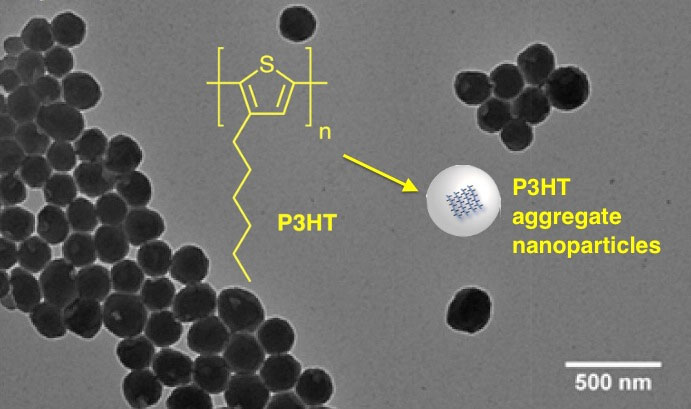
Geometry Is Destiny—for Nanoparticles: Current organic photovoltaic technology relies on forming a high surface area bulk heterojunction (BHJ) between an electron-donating (P) and electron-accepting (N) material, analogous to the flat P-N junction in traditional silicon solar cells. Tremendous effort goes to induce phase segregation to make BHJ regions of optimal size—large enough to ensure continuous pathways for electrical charge transport, but small enough to maximize the areas of contact between materials. A recent approach is simply to design nanoparticles of each material of the desired size, that can assemble spontaneously into a BHJ-type three-dimensional network. Researchers in the Polymer-Based Materials for Harvesting Solar Energy (PHaSE) EFRC at the University of Massachusetts are exploring the tendency of differently sized particles to assemble in predictable ways to create orderly super-lattice nanoparticle crystals using different electronic materials. PHaSE scientists Dhandapani Venkataraman and Michael Barnes compare the approach to integrating spaghetti with meatballs. Using this same approach with all new materials would allow polymer solar cell fabrication with one general recipe, rather than trying to find a completely new recipe for every new material. The approach is already in use to tune structure and properties of nanoparticles of P-type semiconductor polymer, P3HT, shown in the picture. Such P3HT nanoparticles would be one component in the recipe for making a BHJ.
Outlook: Although potential approaches to engineering emergent behavior are as varied as they are in nature, there are unifying factors: robust building blocks with well-defined behavior, and assembly techniques that bring building blocks together in ways that promote a predetermined optimal structure. The challenge remains to design building blocks to fit the rules of the game; that is, the types of interactions that favor the desired outcome. As anyone who has played chess will agree, this can take an hour to learn, but a lifetime to master. Materials scientists using these approaches face similar challenges, but have a similarly breathtaking scope of possibilities.