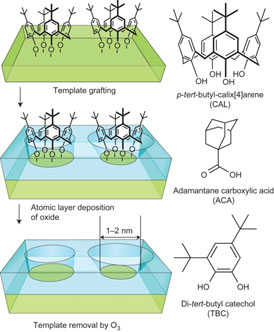
It was a bit of a Goldilocks dilemma. Not too big. Not too small. Only just right would work. Scientists at the Institute for Atom-Efficient Chemical Transformations, IACT, found a way to create pores of just the right size by modifying materials that could be used to selectively convert biomass molecules into renewable fuels and chemicals based on size. They drew inspiration from materials such as zeolites, a type of shape- and size-selective catalyst that has been important for the production of petroleum-based fuels and commodities for years.
“Most biomass molecules and many precursors to commodity chemicals are too large to fit in zeolite pores,” notes Justin Notestein, one of the authors of a paper describing the work that appeared in Nature Chemistry.
To address this problem, IACT scientists started with titanium dioxide, TiO2, a catalyst that reacts fairly indiscriminately with a specific arrangement of atoms known as a functional group. This is useful for some applications like wastewater treatment, but less useful for making fuels or chemicals. The goal of the IACT scientists was to make TiO2 differentiate among molecules that have the same functional group, but different sizes.
Using a series of steps, they attached “bulky” template molecules, about 1 nanometer across, more than 10,000 times thinner than a human hair, to the TiO2. Next, they filled the space between the template with aluminum oxide, Al2O3, in a process known as atomic layer deposition and then burned off the template, exposing the TiO2 underneath. This process left behind a coating of Al2O3 less than 1 nanometer thick that was full of 1-nanometer cavities that worked just like a sieve.
When TiO2 was used for the reaction of two alcohols that differed only slightly in size, the reaction rates were essentially the same. However, when they used the new sieve-like material, they selectively converted the smaller alcohol at a rate nearly 10 times higher than the larger one.
This type of reaction selectivity could be a breakthrough for large industrial applications because it would allow a reaction to be performed as a mixture. This means it would not be necessary to first separate the mixture into its pure components. Skipping separations would save energy and reduce costs. Notestein says, “The types of reactions possible with oxide catalysts, and specifically with the nanocavity catalysts, are potentially much greater than for zeolites.”
The collaborative nature of the Energy Frontier Research Centers, EFRCs, was critical in fostering this breakthrough. Lead author Christian Canlas, a post-doctoral researcher on the project, said, “Demonstrating the existence of 1- to 2-nanometer cavities is challenging, but fortunately, IACT has the resources.”
These resources include a variety of synthesis, characterization, and testing techniques. “This is the type of project that could only be carried out within the structure of an EFRC,” said Notestein.
Both scientists foresee future development. “There is still so much to be learned with this discovery,” says Canlas. This discovery could pave the way towards energy savings, reduced waste, and a sustainable future via new opportunities for catalyst design and optimization.