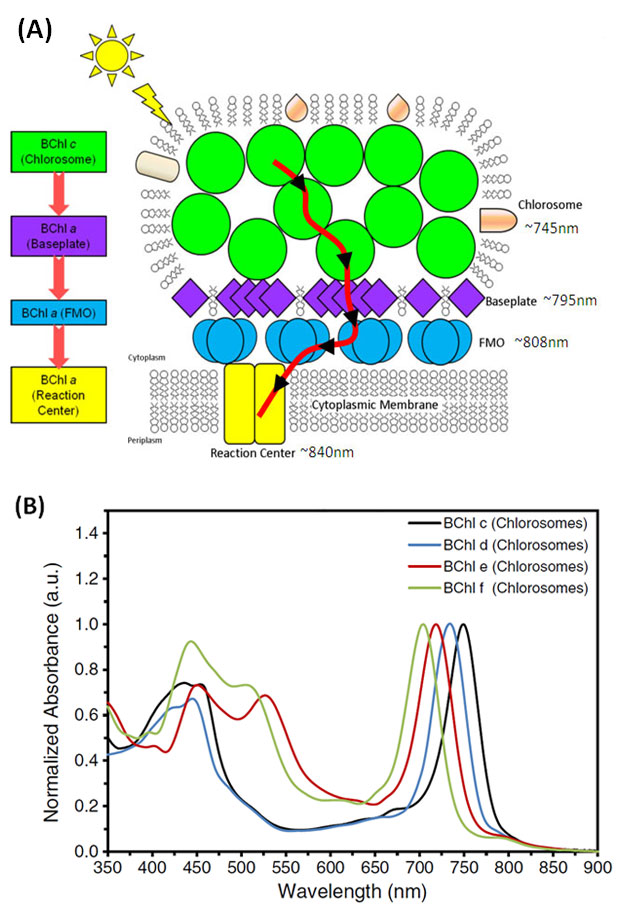
Understanding the process of how bacteria and other organisms absorb light and convert it into chemical energy is vital to creating solar cells and other renewable energy technologies. Photosynthesizing bacteria use pigments, what scientists call bacteriochlorophylls (BChl), that absorb wide wavelengths of light from the absorption spectrum. Within bacteria, especially green bacteria, bacteriochlorophylls c, d or e harvest light over a broad spectrum. Researchers from Washington University in St. Louis and The Pennsylvania State University, at the Photosynthetic Antenna Research Center, PARC, have shown that BChl f, not yet discovered in nature, can be synthesized to increase the range of light absorbed.
The lead investigator at PARC, Robert Blankenship, says, “Our group is interested in this particular research because the light-harvesting systems of green photosynthetic bacteria carry out some of the most efficient solar conversion processes we see in nature. Many scientists believe that the architecture of their system holds secrets that will help us build ultra-efficient solar cells that copy or mimic natural processes.”
One of the main issues scientists face is being able to design a system/device that can utilize a broader spectrum of light, thereby taking full advantage of more of the energy available in sunlight. Photosynthetic bacteria, in contrast to plants, absorb light not only in the visible spectrum, but also in the infrared light (IR) region. This unique feature of such bacteria among all known photosynthetic organisms explains the possibility of their thriving in ecological regions that have extremely low levels of solar radiation.
One such bacterium is the green photosynthetic bacterium that contains an organelle known as the chlorosome. Chlorosomes are light-harvesting “antenna” complexes, which naturally contain BChl c, d or e as the principal light-harvesting pigments. The team of PARC researchers has hypothesized that there may be yet another BChl, which they term the forbidden chlorophyll: BChl f! This led the team to show, by genetic manipulation and spectroscopic analysis, that if found in nature, BChl f-containing organisms would require a high irradiance niche. These organisms containing BChl f have had more than 2 billion years to adapt to this niche, allowing for the possibility that organisms producing BChl f may be found in nature.
The team of PARC scientists showed that the human-made BChl f had similarities to BChl e and d. This information allowed them to create a mutant within the green bacterium to produce BChl f. Through spectroscopic analysis such as fluorescence emission, they explained why the mutant organism containing BChl f grows slower than the wild type. The low energy transfer efficiency of BChl f compared to e, which is found in the natural system, could be caused by the increased range of wavelengths of light that the organism can absorb.
As the hunt for the organism containing the BChl f goes on, properties of this pigment may prove beneficial to artificial photosynthesis strategies. Greg Orf, one of the lead researchers, says, “This research reinforces the idea that, in many ways, nature has already come up with amazing ways to harness solar energy. If we could find a way to combine the beneficial properties of multiple natural pigments (or synthetic mimics of them) into a cohesive light-harvesting system, we could change the landscape of solar energy production.”