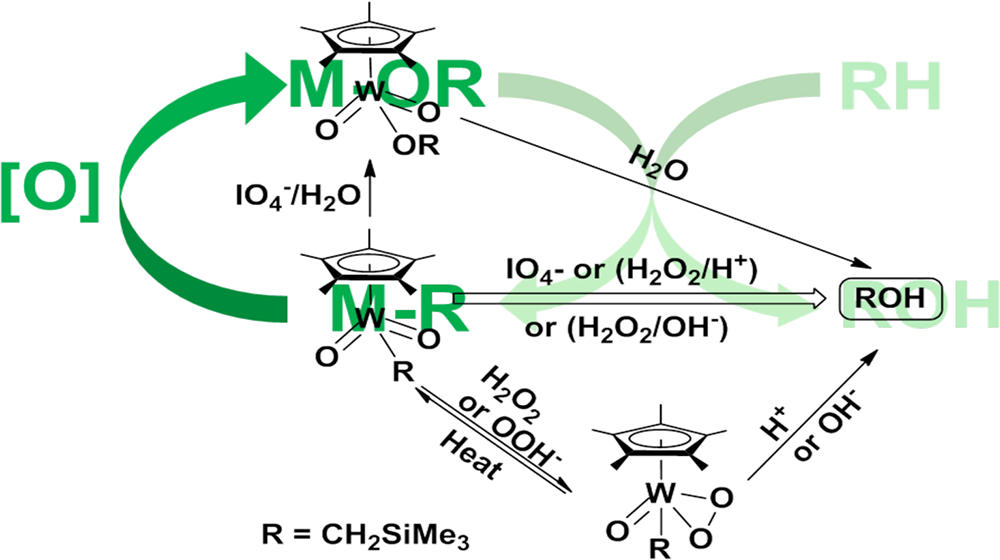
Researchers at the Center for Catalytic Hydrocarbon Functionalization, or CCHF, found three pathways to add oxygen atoms, known as partial oxidation, to hydrocarbonyl ligands in tungsten complexes to ultimately create alcohol, which is a valuable chemical intermediate and fuel. A ligand is a group or molecule that binds to a metal center in a complex. In collaborative work between the Gunnoe (University of Virginia) and Cundari (University of North Texas) groups, Jiajun Mei and coworkers have been investigating the oxidization of hydrocarbons, which is an extremely important process in the fossil fuel industry. The burning of fossil fuels is a common example of hydrocarbon oxidation; however, selective partial oxidation without radical or highly reactive intermediates is a difficult problem.
One of the most difficult aspects of determining the mechanism or route that a chemical reaction takes is determining the transition states—the high-energy hills it must climb along the way. Transition states are fleeting, and because these intermediate structures exist for short periods of time, they can be extremely difficult—many times nearly impossible—to characterize experimentally.
Mei and his team focused on inserting an oxygen atom into the hydrocarbonyl ligand of the tungsten complex and forming a carbon-oxygen (C-O) bond. This C-O bond is ultimately split off and converted to an alcohol (C-OH). Through a battery of experimental reactions under variable conditions, in concert with mathematical calculations to determine bond lengths and the geometries of suspected intermediates at key points in the reaction, the CCHF chemists proposed three distinct routes. In addition to a detailed understanding of reaction mechanisms, by varying the oxidizing agent chemical that provides the oxygen and reaction conditions, the researchers determined which conditions result in the fastest reactions. The information obtained here can help guide the design of metal complexes for hydrocarbon functionalization using other systems and applications.