Batteries and other electrical energy storage technologies rely on an liquid electrolyte to carry charge. In lithium-ion batteries, popular in electric cars and cell phones, the electrolyte shuttles charged bits, called ions, from one electrode to another, allowing the battery to power a laptop computer or cell phone. In capacitors, a different type of storage device, the electrolyte helps stabilize the energy stored by static voltage. For both of these energy storage devices, the electrolyte hugely impacts storage capability. Seeking to improve existing capacitor tech by this means, scientists at the Fluid Interface Reactions, Structures and Transport (FIRST) Center, an Energy Frontier Research Center, are exploring a unique class of electrolytes, called room temperature ionic liquids (RTILs).
Room-temperature ionic liquids, or RTILs, differ from normal liquid electrolytes in a very significant way. Normal electrolytes have two parts: a salt and a solvent, which allows the salt to dissolve into ions that carry charge. However, this means the solvent limits the storage conditions in a capacitor, such as electrical voltage and structure. The RTILs remove that limitation because they are effectively liquid salts at room temperature. To melt common table salt requires temperatures of around 800 oC, which is not feasible for current capacitor technology. Taking out the “middle man” of a solvent opens the possibility for capacitors to significantly increase their storage capabilities. Scientists at FIRST recently made vital discoveries concerning RTILs’ interactions with surfaces and in confined spaces, two important architectural details for maximizing capacitor energy storage.
Structure matters: Experiment-based modeling reveals structural impacts. As computational technology has improved, scientists have come to rely on experiment-inspired simulations as a means to understand chemical interactions at the smallest scales. This is especially important for RTIL-based capacitors because many suggested designs implement micro- and nano-structured components. A group of scientists at FIRST, led by José Bañuelos and Guang Feng, coupled experiments with such simulations to understand these short length-scale interactions. After validating their preliminary simulations through experiment, the scientists extended their computer models to more closely study how the structure of the capacitor influenced ion distribution and motion.
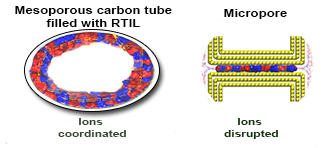
The RTIL demonstrated significant coordination between its ions in all simulated structures, which means ions of different charges still interacted strongly with each other regardless of how confined they were. This generally leads to a very structured layering of ions near a surface, which makes it difficult for ions to move at the nanoscale. However, when simulated structures entered the nanometer regime (100,000 times thinner than a human hair), this coordination-based layering was disrupted. Tiny pores less than 1 nanometer in diameter disrupted this coordination for ions, which weakens the interaction between ions and the pore wall. The weakened interaction assists ion movement, which in turn increases the speed at which ions can reorganize, an advantageous property for capacitor charge and discharge. This study opens up investigations to using a balance between dual-length scale constructions to optimize potential structural impacts on RTIL-inspired capacitors.
Surface matters: Lasers illuminate ion-surface interactions. Capacitors store energy by suspending a voltage in electrolyte between two different electrodes. While this property of voltage was not considered in the nanoconfined RTIL study for ion-surface interactions, a different group at FIRST led by Shannon Mahurin investigated this question more closely. They pioneered the use of a technique known as surface-enhanced Raman spectroscopy (SERS), which uses laser light of varying frequency to directly probe molecular interactions at a surface. This technique relies on using the different light frequencies to excite molecular bonds with specific energies. This is similar to using different pitches to resonate tuning forks. As specific pitches resonate tuning forks, causing them to emit sound, light of certain frequencies “resonate” different molecular bonds, causing vibrations that can be detected and identified.

What Mahurin and his team found was the RTIL they were studying had a preferred orientation on the graphene electrode surface from the start. Adding voltage only served to enhance the effect. Their findings agreed with other independent results that validated SERS as a method to study these types of interactions in the future. More important, it revealed how a material’s surface can play a significant role in energy technology.
Composition matters: Room-temperature ionic liquid mix improves performance. While RTILs do boast a higher voltage range for use, there can be challenges implementing them because of the asymmetry between the positive and negative ions that comprise them. A simple way proposed to mitigate this is to mix different ionic liquids to balance performance. However, the effects of mixing are not well understood, leading another team from FIRST supervised by Jianzhong Wu to investigate a mixed RTIL system with both modeling and experiment. Both theory and experiment showed mixing the two RTILs under investigation (EMI-TFSI and EMI-BF4) produced better results than either RTIL individually.
To find out why, the team dug deeper into the modeling, revealing a result similar to that seen in the structural analysis done by Bañuelos and Feng referenced earlier. The RTILs organized themselves in ionic layers at the surface, which had the effect of screening, or dampening, the voltage. The mixing of RTILs disrupted these layers by the differences in ion size. This reduced the voltage screening, which in turn led to a higher capacitance. Given the high level of agreement between theory and experiment as well as the simplicity of the technique, mixing may be implemented to a greater degree in the future.

More than just academic. The efforts from FIRST in investigating RTILs have added to both methods of study and knowledge of their behavior in different environments. As understanding increases about RTILs through the use of these methods and principles, the more their advantages may be used in the future for capacitors, batteries, or other energy storage technologies.