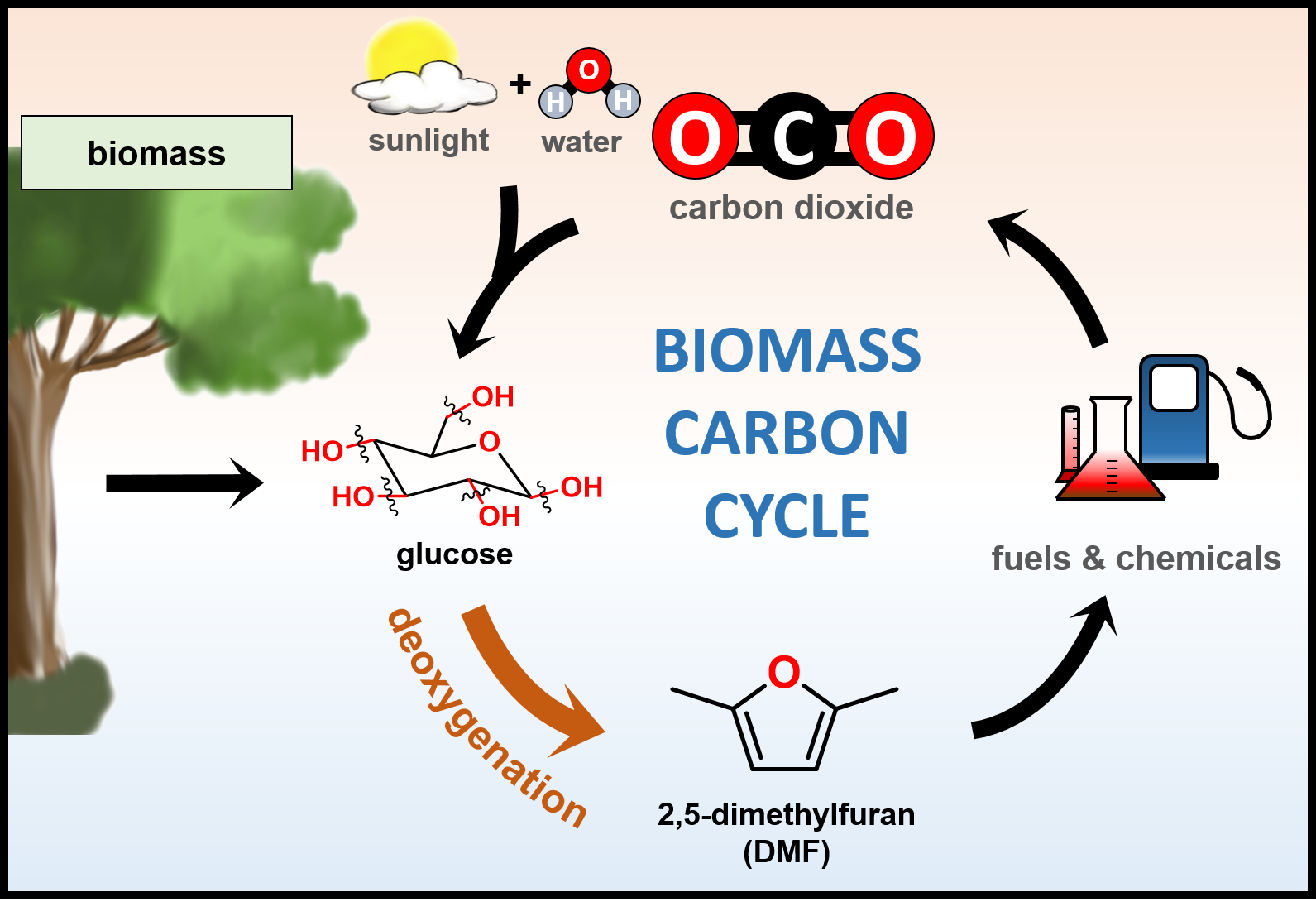
Plants are remarkable at converting sunlight, water, and atmospheric carbon dioxide into sugary glucose through a process called photosynthesis. While glucose acts as a food source for living organisms, it is also one of nature’s only renewable carbon sources. Poplar trees and switchgrass make up just a few sources of biomass-derived glucose from which we can produce many of our modern commodity chemicals and fuels.
Great! We can just replace our petrochemically derived fuels and chemicals with sugar-based ones, right? Unfortunately, it is not that simple. Along with carbon, glucose contains oxygen. In fact, oxygen makes up roughly 50 percent of a glucose molecule. In stark contrast, fossil fuels typically have very low oxygen content (less than 5 percent). Thus, removal of oxygen—or deoxygenation—remains the grand challenge in using biomass to produce usable fuels.
However, with advances in biomass conversion at Energy Frontier Research Centers such as Catalysis Center for Energy Innovation (CCEI) and Center for Direct Conversion of Biomass to Biofuels (C3Bio), this possibility is becoming increasingly feasible.
Clean ways and messy ways to remove oxygen. There are several ways to remove oxygen from carbon chains. One way is to use strong acids to remove oxygen in the form of water, but these acids are corrosive and are undesirable in large-scale chemical plants.
Instead, metal or metal oxide nanoparticles can be used as catalysts to facilitate deoxygenation by speeding up the rate of a desired chemical reaction (carbon-oxygen bond removal) while eliminating undesired side reactions. Combining such catalytic materials with hydrogen creates a recipe to efficiently remove carbon-oxygen bonds and replace them with carbon-hydrogen bonds in a benign and non-corrosive way. However, tuning this chemistry to be selective for deoxygenation at high conversion remains elusive.
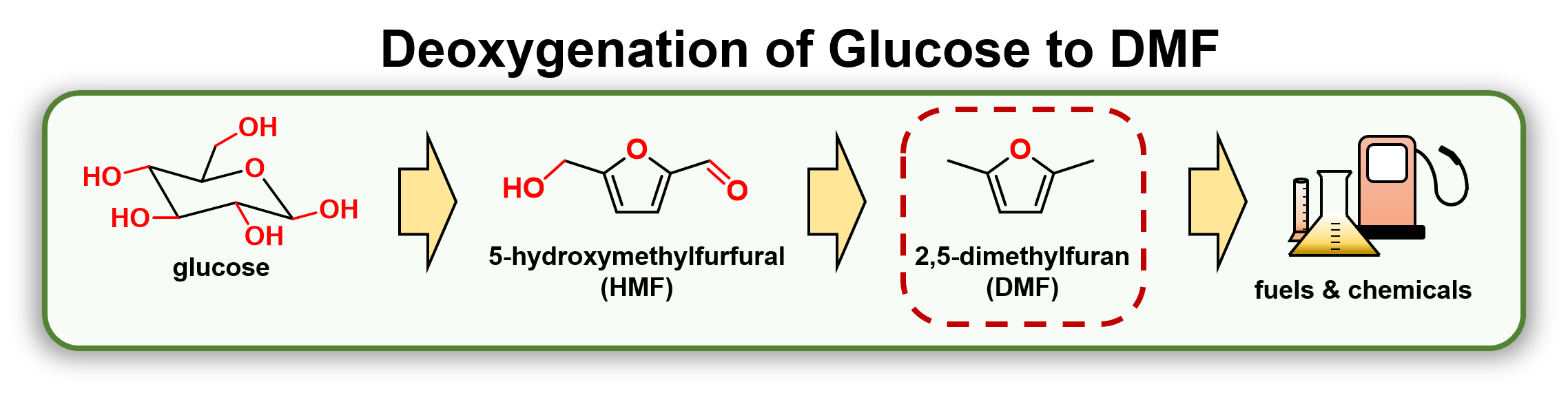
Typically, the first step in glucose conversion is to break it down into a platform chemical known as 5-hydroxymethylfurfural, or more simply, HMF. The benefit in doing so is to create a simpler building block that scientists can subsequently convert to a wider range of commodity chemicals. Unfortunately, HMF is still highly oxygenated. Recently, CCEI unraveled key insights into deoxygenation of HMF into 2,5-dimethylfuran (DMF), a high-energy fuel with an octane number higher than that of gasoline.
Researchers discovered that to effectively remove carbon-oxygen bonds, multiple types of active sites—the point on a catalyst where a chemical reaction occurs—are required on a catalytic material. Through a combination of experimental and theoretical contributions, CCEI scientists found that ruthenium (labeled “Ru” on the periodic table) exhibits very desirable properties for deoxygenation because of its ability to form metallic phases as well as metal oxide phases. These phases act synergistically to carry out the chemical reaction.
Researchers at C3Bio discovered a similar theory after employing a bifunctional zinc- and palladium-based catalyst to remove oxygen from other biomass-based oxygenated compounds, where zinc introduces metal oxide sites and palladium introduces metallic sites. This catalyst resembles that of CCEI by combining two types of synergistic active sites.
In essence, metal oxide phases create an electron-deficient metal atom, which allows electron-rich species such as oxygen atoms to bind. This provides highly oxygenated molecules such as HMF an access point onto the catalyst surface. Once bound, a nearby metallic site can then incorporate a bound hydrogen into the bound molecule, simultaneously breaking a carbon-oxygen bond in the molecule and forming a carbon-hydrogen bond in its place. Without both types of sites on the catalyst surface, removal of oxygen from the molecule cannot occur as effectively.
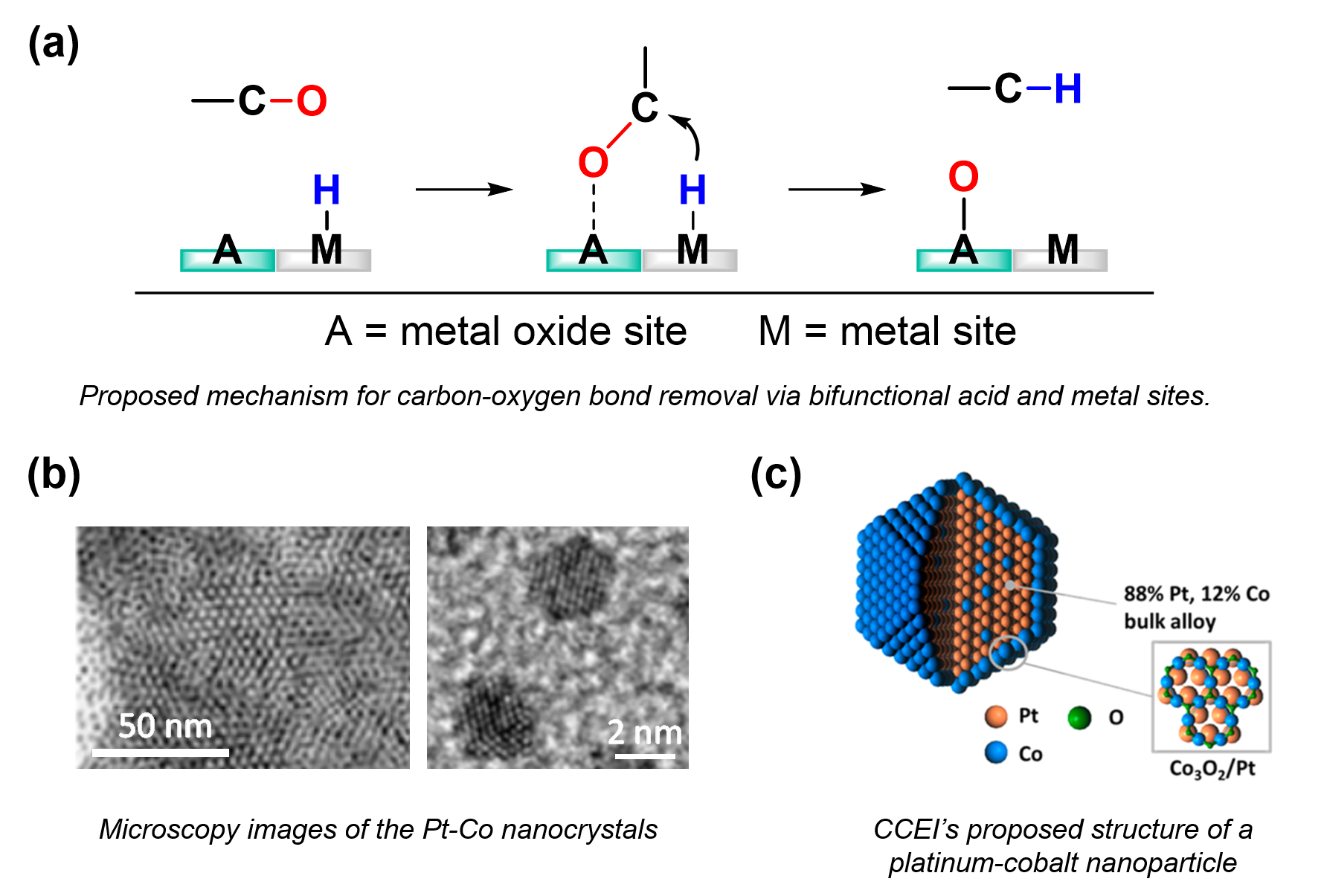
Lifting deoxygenation catalyts to the next level and beyond. The general design strategy that arose from CCEI and C3Bio has most recently led to the design of new, more stable, and more efficient materials for deoxygenation. This past month, CCEI developed a highly active catalyst by alloying platinum and cobalt into highly structured metal nanocrystals (see figure). The catalyst converted HMF to DMF with 98 percent yield! What’s more, the stability of the catalyst is unrivaled, lasting longer than 10 hours, which is a remarkably long lifetime compared to many conventional catalysts.
Interest in biomass will continue for the foreseeable future, and optimal strategies for transforming it into fuels or useful chemicals by oxygen removal are non-trivial, but nonetheless possible. By developing theories and designing efficient catalysts such as those at CCEI and C3Bio, processing of biomass will become more and more viable, contributing to the creation of a more carbon-neutral society.