

As our energy demands continue to grow along with looming global climate change, there is an imminent need to replace fossil fuels with sustainable and clean sources of energy. Solar energy has been recognized as the most prominent source for future needs. Consequently, about half of the 32 Energy Frontiers Research Centers (EFRCs) are focused on understanding and exploiting fundamental science to improve solar energy technologies. In this feature, we will review the unique approaches taken by different EFRCs and highlight several recent achievements.
The two primary targets of solar energy harvesting are the production of electricity and chemical fuels. Both processes involve the absorption of sunlight by a substance to energize electrons, and the transport of the electronic energy through the substance. While the flow of energized electrons directly gives electricity, chemical fuels production requires a catalyst to store the energy in chemical bonds. These processes can be improved in three ways:
- discovery of superior substances
- effective use of available sunlight
- novel energy conversion schemes.
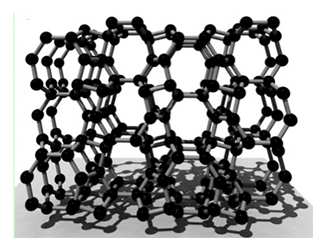
In principle, any substance that absorbs light can harvest light. While the possibilities are innumerable, scientists are hampered by the trial-and-error approach of materials discovery, a slow process that is often followed by decades of optimization. Scientists at the Center for Next Generation of Materials by Design (CNGMD) and the Center for Computational Design of Functional Layered Materials (CCDM) are adapting a more systematic approach. They predict the properties of a large number of undiscovered materials using computational method. They synthesize the most promising candidates using advanced experimental techniques. While researchers at the Energy Frontiers Center in Extreme Environments (EFree) use a similar approach, it also exploits the potential of extreme environments, such as high temperature and pressure, for synthesis of new materials.
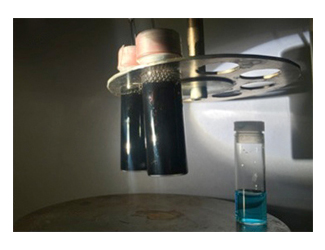
Similarly, scientists at the Argonne-Northwestern Solar Energy Research Center (ANSER) are developing new classes of materials for electricity and fuels generation. For example, they made solar cells using different forms of carbon to absorb light, embedded small catalyst particles in highly porous structures to produce hydrogen, and replicated nature’s ability to convert nitrogen (80 percent of the air we breathe) to ammonia, a key component in the fertilizer used to grow crops to feed the world.
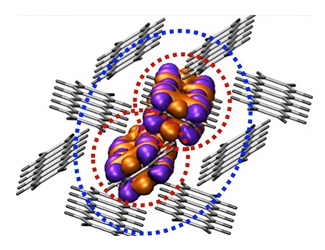
The fundamental processes of light absorption and electron motion in materials are at the core of the Center for Advanced Photophysics (CASP) and the Center for Excitonics (CE). The group of Victor Klimov at CASP is studying small, light-absorbing and -emitting particles. In a recent study, they examined the properties of crystals containing copper, indium, selenium, and sulfur that represent promising materials for the realization of low-cost solar cells. At CE, the groups led by Marc Baldo and Troy Van Voorhis are exploring new physics of "exciton fission," where one particle of light excites many electrons in a material instead of just one. Exciton fission will potentially reduce heat loss and enhance output electrical current in solar cells.
Looking beyond light-absorbing materials, the Light-Material Interactions in Energy Conversion (LMI) is devising new ways to use the full spectrum of sunlight most efficiently. These include structuring materials for maximum absorption, recycling unused light, and concentrating it before use. In a unique twist, scientists demonstrated efficiency improvements by separating sunlight based on energy, and supplying each portion to appropriate solar cells that convert it into electricity most effectively.
Many centers look to nature for inspiration on light harvesting. With this notion, the Photosynthetic Antenna Research Center (PARC) is studying biological photosynthesis in depth. At the same time, they use this knowledge not only to improve the efficiency of natural photosynthesis but also combine natural and human-made materials for practical light-harvesting uses. Similarly, the Center for Bio-Inspired Energy Science (CBES) combines expertise in biological and human-made materials for designing materials with bio-inspired function.
Others harness natural processes for direct fuel generation. The Center for Direct Catalytic Conversion of Biomass to Biofuels (C3Bio) and the Biological Electron Transfer and Catalysis (BETCy) are exploring ways to convert biomass into biofuels, which is essentially driven by solar energy. While C3Bio is focusing on the chemistry of biomass to biofuels production and subsequent optimization, BETCy is studying the flow of electrons and ions in enzymes to optimize microbial production of biofuels.
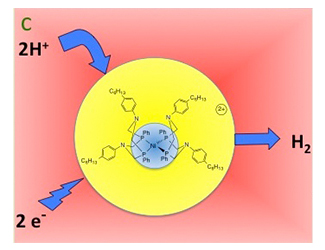
In contrast, the Center for Solar Fuels (UNC) has taken up the challenge to making artificial solar fuel generation technologically viable. Taking a cue from natural photosynthesis, they are designing and developing a special type of solar fuels device. In this device, molecules are placed at the interface of a solid and solution. These molecules absorb light and catalyze fuel production through water splitting and carbon dioxide conversion reactions. In equal spirit, the Center for Molecular Electrocatalysis (CME) has embarked upon a pursuit to design efficient fuel-producing molecules, which remains one of the key challenges in solar fuels production.
There are other avenues for efficient solar energy harvesting. The Solid-State Solar-Thermal Energy Conversion Center (S3TEC) is developing a parallel technology, where solar energy heats up an object, and this heat is converted into electricity in different ways. In one method, heat waves (infrared light) emitted by the hot object are captured by solar cells to produce electricity. In another method, the temperature difference between the hot object and the surrounding is converted into electricity. The fundamental understanding of heat conduction is crucial to designing such materials. Gang Chen and his collaborators developed simulations and experimental tools to advance the understanding of heat conduction at nanometer scale, opening avenues for future development in this field.
It’s hard to predict how fast we will be able to replace fossil fuels with clean and sustainable sources of energy. The opportunities are many, but so are the challenges. The EFRCs remain committed to making advancements in solar energy harvesting through collaborative endeavors.