
All batteries lose energy because of internal resistance, which is why batteries get hot after long use. To make more efficient batteries, scientists are researching methods to lower internal resistance. Mya Le and her colleagues from the Energy Frontier Research Center Nanostructures for Electrical Energy Storage (NEES) approached the challenge of internal resistance for the case of tiny electrodes, a key component for new, novel battery design. Understanding internal resistance could lead to "nano-batteries" that take advantage of nanoscale structures to improve electrical energy storage, lasting longer and delivering more energy than conventional technologies.
Le and the team discovered that the conductivity of manganese dioxide (MnO2), a commonly used material in lithium-ion batteries, scales inversely with its size when charged, which could directly impact the efficiency of these nano-batteries.
MnO2 as an electrode for lithium-ion batteries is a bit like a sponge in water. As a sponge absorbs water and releases it when squeezed, so MnO2 takes in lithium ions when charging and releases them when the battery is put to use in a cellphone or laptop computer. But, just as a sponge needs a hand to squeeze it dry, a MnO2 electrode requires electrons to move to release lithium. Optimizing electron motion is crucial for maximizing the performance of batteries that rely on these tiny or nano-sized electrodes.
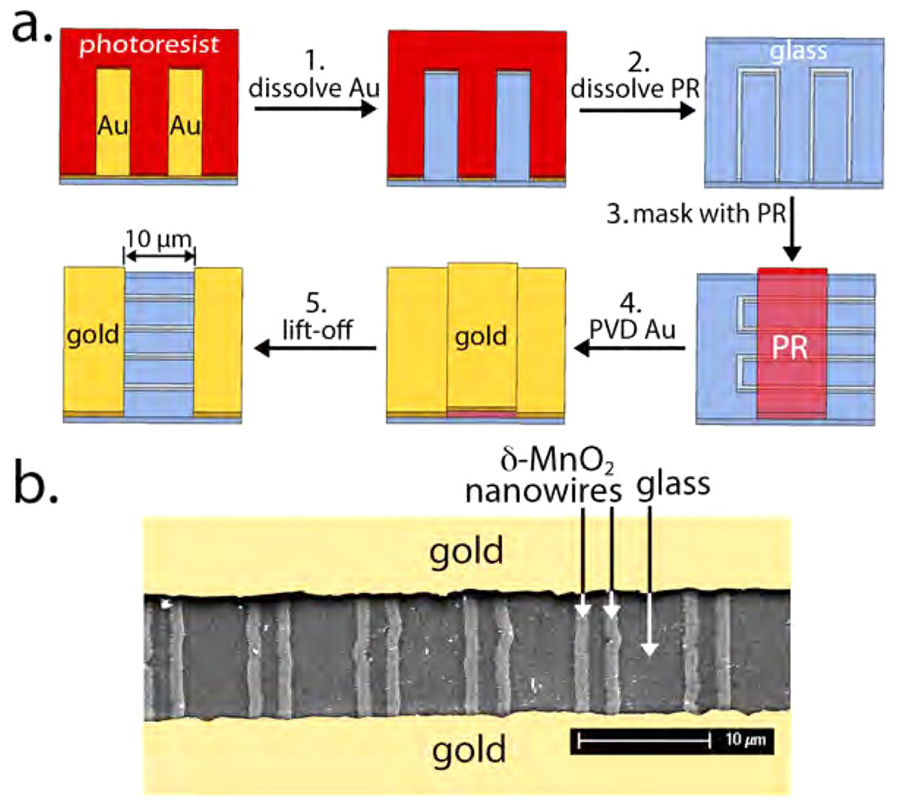
To make the nano-electrodes, Le employs a technique called lithographically patterned nanowire electrodeposition.
Le specifically examined the MnO2 nano-electrodes while charged with lithium to determine how conductivity changed in electrodes of varying widths. When she did this, she discovered that charged wires with smaller cross-sections exhibited higher electrical conductivities. In other words, a thinner wire allowed electrons to move more easily than a thicker wire. Normally, a thicker wire allows for easier electron movement, so, confronted with this strange result, Le decided to examine the structure more closely to understand why.
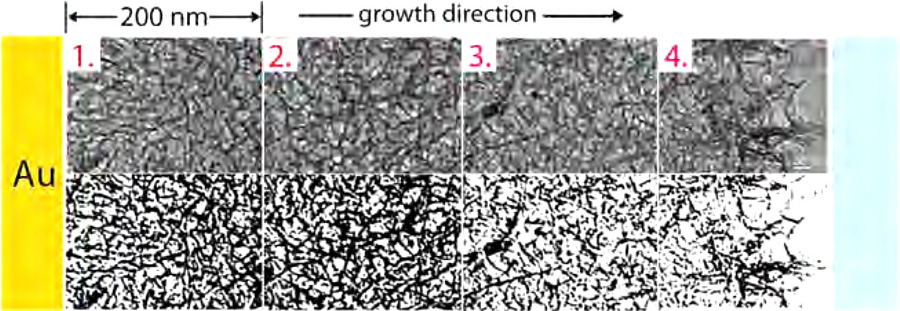
Under a transmission electron microscope, the team discovered the porous structure had tendril-like characteristics. Dense "roots" dominated the structure near the gold contact, and branched out, tapering with distance. This led the team to suggest a growth mechanism for MnO2: the initial deposition was consistent in rate, but as time went on, the thickness along these tendrils became disparate, as diffusion properties of the depositing MnO2 changed. The team concluded that the dense roots in wider nano-electrodes prevent lithium ions from being taken in. This would lead to the roots having a lower electrical conductivity because lithium ions increase the conductivity of the material. Computer models later revealed that lithium creates conduction channels in MnO2, where electrons may more freely move. These two effects explain the strange finding of how the smaller width could lead to higher material conductivity and provide insight into overcoming the challenge of internal resistance at the nanoscale.
While nanobatteries face other challenges before being ready for commercial use, these small structures have the potential to make big changes in energy storage.