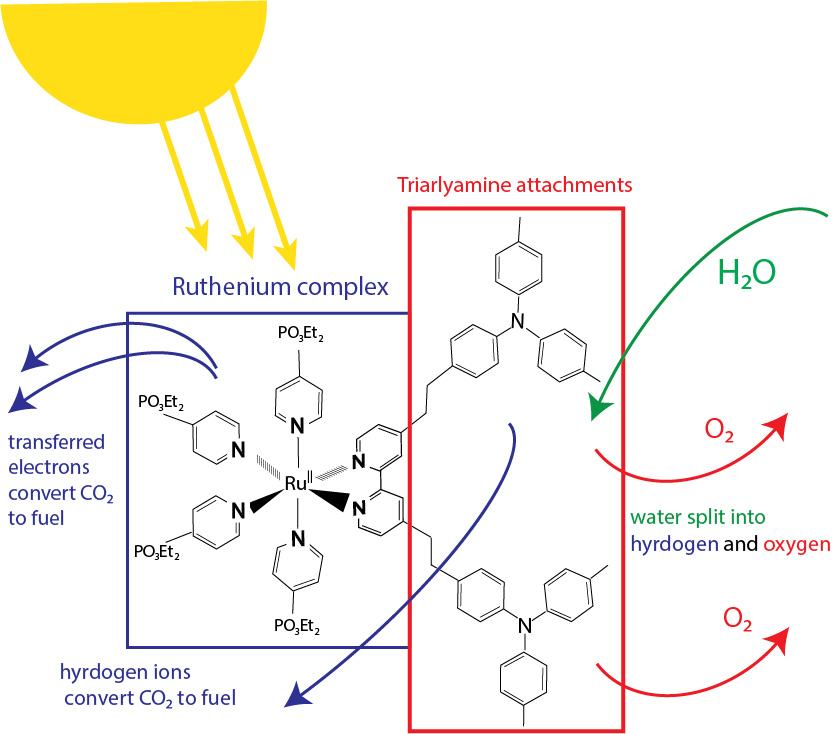
Photosynthesis is the way that plants use sunlight to produce food. Ultimately feeding the lifecycle of the entire biosphere, photosynthesis is the primary energy source of life on Earth. In this process, plants take in carbon dioxide from the atmosphere and then use the energy from the sun to convert the carbon dioxide into sugars that plants consume as food. Because the overall process turns carbon dioxide into potential biofuel building blocks and produces energy, there is a great interest among scientists to harness and replicate the mechanisms of natural photosynthesis in the laboratory. This field is referred to as artificial photosynthesis.
Artificial photosynthesis can benefit society in two ways. First, it has the potential to be used as a “green” energy source; that is, a way of producing energy that does not emit carbon dioxide. Secondly, it may be used for carbon dioxide sequestration, which is to pull the carbon dioxide right out of the atmosphere. Artificial photosynthesis may be a valuable tool to mitigate climate change due to the release of carbon dioxide during the burning of fossil fuels. The current challenge is to make this process efficient enough to be useful to society.
One of the biggest challenges in achieving artificial photosynthesis has been to efficiently split water into hydrogen and oxygen. Natural photosynthesis is controlled by a collection of molecules referred to as Photosystem II. When Photosystem II absorbs sunlight, it drives a two-sided reaction. On one side, water molecules are split into separate hydrogen ions and oxygen molecules. On the other side, electrons are transferred from Photosystem II to other molecules. The released hydrogen ions and transferred electrons are both necessary to chemically convert carbon dioxide from the atmosphere into sugars.
Researchers at the Alliance for Molecular PhotoElectrode Design for Solar Fuels (AMPED), formerly known as the UNC EFRC Center for Solar Fuels, have recently made a breakthrough that may significantly enhance artificial photosynthetic efficiency and practicality. They designed and studied molecules that help maintain the water-splitting side of the reaction. The scientists started with a molecule that is commonly used to absorb light and create the electron-transfer side of the reaction, known as ruthenium polypyridyl. They then chemically attached new molecules called triarylamines onto the ruthenium molecule. These additional triarylamine molecules performed in a similar manner as the molecules in natural photosynthesis do. Through detailed measurements, the scientists studied the way the molecule responds when exposed to light. The triarylamines helped to mimic the water-splitting side of the reaction of photosynthesis. Furthermore, the researchers directly demonstrate the ability of this molecule to produce electricity from sunlight in a photochemical cell.
The design and discovery of a molecule that can successfully replicate the behavior of water-splitting in natural photosynthesis is an important breakthrough, but it also may be just the beginning. The scientists still need to study how efficiently the molecules can produce biofuels in artificial photosynthetic devices and hope to optimize the properties of the molecules for this purpose. Fortunately, the triarylamines are a whole family of molecules that can be systematically tailored to achieve the best results. With this achievement, the researchers at the AMPED center have made a key step towards harnessing artificial photosynthesis and providing solutions to issues stemming from the use of carbon-based fuels.