On a hot, sunny day, surfaces such as asphalt can become blisteringly hot. Yet some materials stay cooler than the surrounding air even in direct sunlight. Scientists at the Light‑Material Interactions in Energy Conversion (LMI) Energy Frontier Research Center demonstrated over 8 °C cooling below the air’s temperature using a simple device made from abundant, inexpensive materials. These devices open the door for passive cooling, cutting energy consumption by air conditioners and fans.
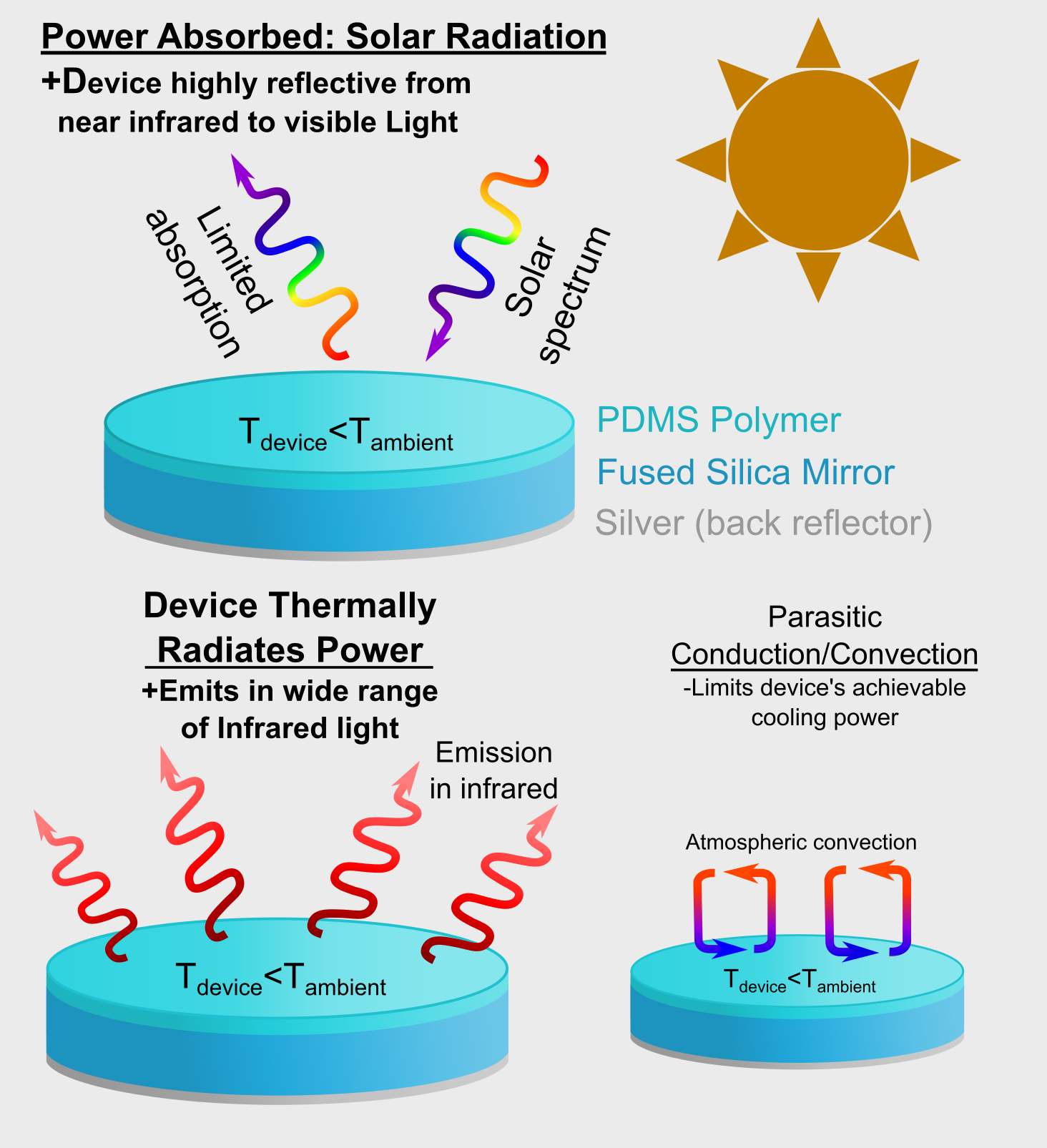
To keep cool, the device needs to emit power to the surroundings while minimizing the power absorbed. Power is absorbed through thermal radiation from the sun and atmosphere and also through conduction/convection from contact between the air and device. Power is emitted from the device through thermal radiation. While all objects emit thermal radiation (including humans), some objects are better than others, depending on their emissivity, which is a measure of how well an object can emit thermal radiation.
The device engineered by the researchers at LMI has a simple three-layer structure: a polymer coating, fused silica mirror and thin silver back reflector. Each of these layers plays an important role in maximizing cooling power. The layers were first selected to minimize heating in direct sunlight. The polymer coating and fused silica mirror absorb only a tiny fraction of sunlight. The silver back layer is highly reflective and prevents sunlight from passing through the device.
High emissivity of the device in the infrared enables cooling below air temperature. However, good thermal emitters are also good absorbers, and the device will absorb radiation in the same wavelength region of high emissivity. Thermal radiation from the air is then absorbed by the device in wavelength regions of overlap between their respective emissivity/absorption windows. Previously, complex nanostructures were designed to only have high emissivity/absorption in a very selective infrared window. This avoided absorption of thermal radiation from the air as this radiation was thought to significantly limit the achievable device’s cooling power. In contrast, the polymer coating and silica mirror layers emit in a wide infrared window that overlaps with thermal radiation from the air.
Surprisingly, the device engineered by the LMI researchers could achieve better performance than these complex nanostructures, despite infrared regions of emissivity/absorption overlapping with air. By modeling the cooling power, the researchers at LMI identified that a wider emissivity window can be preferable when the device is only a few degrees Celsius below the surrounding air. In this case, the parasitic conduction/convection from the air is responsible for limiting the cooling ability of the structure.
By moving away from the complex nanostructured devices to a simple three-layer device, these researchers took an important step in the development of electricity-free cooling devices. While more work is needed in material selection and design to optimize the emissivity/absorptivity spectrum, these researchers’ use of abundant materials in a simple device structure increases the feasibility of these devices for a range of cooling applications.