

Are you thinking of getting a hydrogen-powered car that is environmentally friendly? Are you wondering where you’ll get the hydrogen fuel? How should it be produced with minimal environmental impact? Recently, researchers from the Center for Advanced Solar Photophysics (CASP), an Energy Frontier Research Center, developed a solar-powered fuel cell that can produce hydrogen exceeding 100 percent efficiency upon visible light irradiation.
Fossil fuels are used to make electricity and to run our cars. However, they have some serious issues, notably that they are finite. Clean and renewable energy sources are needed to remedy this problem. What is the most abundant and sustainable renewable energy source? The sunshine we see every day. One way to produce hydrogen fuel from sunlight uses a light-absorbing material submerged in water. Absorbing light excites an electron. This electron is delivered to the appropriate catalyst surface, generating electricity to facilitate the production of hydrogen. Sunlight might be free and abundant, but current catalysis technology is expensive and inefficient. One great challenge taken up by scientists at CASP is to develop low-cost and more efficient light-absorbing materials.
A new strategy to improve the efficiency, as the researchers used in the recent study, is to make a more efficient light absorber, taking advantage of quantum dots. What are quantum dots? Some of you might have not realized it, but it might already be used in the liquid crystal display (LCD) screens of your phone, tablet, TV or laptop. Quantum dots are semiconductors with unique optical properties that can make the LCD screen brighter and clearer. How so? Their small size. They are in the range of 2 to 10 nanometers (10−9 meters) in diameter. Based on their sizes, they emit different colors of light; for example, smaller particles appear blue, and slightly larger ones are red.
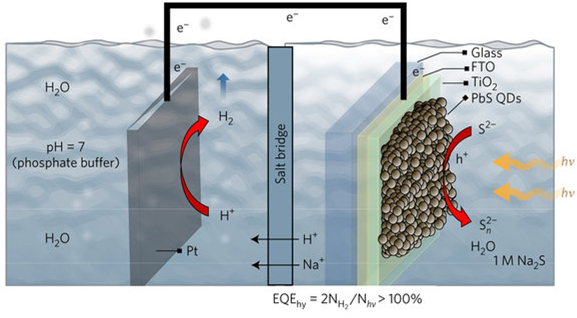
In traditional solar-to-fuel devices, the absorption of a bit of light, called a photon, usually generates one excited electron. But with quantum dots, multiple excited electrons may be produced from absorption of a single high-energy photon. The reason is, again, their unique small sizes. Assuming 100 percent efficiency occurs when all the “single electrons generated by one photon absorption” are used to produce hydrogen fuel, then the multiple electrons generated by quantum dots upon one photon absorption can make the efficiency higher than 100 percent possible. Researchers at the CASP have fabricated such a solar-powered hydrogen-producing fuel cell using electrodes coated with quantum dots. Researchers built this electrode in a layer-by-layer fashion, where lead sulfide quantum dots are deposited on the electrode surface. Upon being hit with light of sufficient energy, each quantum dot sends multiple electrons to the platinum electrode producing hydrogen fuel (see figure). The light-to-fuel production efficiencies exceed 100 percent at several tested wavelengths.
Generating solar fuels, such as hydrogen, using a low-cost material with high efficiency remains a great challenge. This study shows that quantum dots, with unique electron properties, could be a key ingredient necessary for widespread adoption of hydrogen fuel. Initial tests have shown great progress, but there is a long way to go still.
