For a materials scientist, it is an unfortunate fact of life that diamonds are not forever.
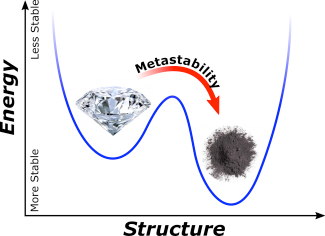
When seeking to make new and useful compounds, scientists have traditionally attempted to target materials that are thermodynamically stable, which means that they can exist indefinitely without changing structure or composition. However, there are a vast number of materials known to science that are metastable, which means that under the right conditions or after a long enough wait, the materials will spontaneously transform into a different, more stable substance.
Diamonds fall into the category of metastable materials. At atmospheric pressure, over eons, a diamond will slowly transform into graphite. Even living things rely on metastability to exist — it is thermodynamically favorable, for instance, for a tree to spontaneously combust in Earth’s atmosphere. Fortunately for us, there are energetic barriers that prevent this from happening.
Metastable materials are increasingly important in energy production and storage, as many promising new components of solar cells, batteries and catalysts fall into this category. As a result, scientists working at the Center for Next Generation of Materials by Design: Incorporating Metastability (CNGMD), an Energy Frontier Research Center, are intensely interested in learning how to predict which metastable materials, out of the vast number of possibilities, can actually be synthesized and used.

In the past, materials synthesis was mostly done through trial and error coupled with chemical intuition — for instance, a metastable compound that is similar to a stable compound might be considered a safer target than a wildly different material. This is because metastability also has a characteristic scale, which reflects the size of the free energy difference between a metastable compound and the thermodynamically stable compound made of the same constituents. The larger this difference, the less stable the compound.
Researchers at CNGMD sought to crystallize these old heuristics with hard data for the first time. With a limited number of metastable compounds for which experimental thermodynamic data is available, Wenhao Sun and his co-authors turned to the rapidly developing field of high-throughput materials screening, which utilizes advances in computational simulation of materials at the atomic level to predict both stable and metastable compounds.
The researchers utilized two data sources to reveal trends in metastable materials. First, they identified nearly 30,000 known materials, both stable and metastable, from an online database. Second, they determined the scale of metastability of each compound by pulling thermodynamic data from the Materials Project, an openly accessible compendium of calculations of thousands of materials’ properties. This big data approach, which allows the examination of far more materials at once than is practical to do experimentally, revealed some surprising conclusions helpful to researchers attempting to make metastable materials.
It turns out that the ability to successfully form a metastable material depends on both its specific chemistry and its compositional complexity. The authors discovered that compounds made with ions with larger electrical charges — for instance, nitrogen with a typical charge of -3 — were more able to form metastable compounds than those with less charged ions, such as oxygen or fluorine. They hypothesize that this is because nitrogen can form exceptionally strong and directional chemical bonds, which makes it difficult for a compound to spontaneously reconfigure itself into the most thermodynamically stable state.
Analysis also revealed a surprise when it came to the metastability of complex materials. Compounds with five or more constituent elements more easily formed metastable phases compared with simpler materials made of three or four elements. This likely involves the method by which materials eventually decompose into their most stable forms. Simple metastable materials might decompose through a local rearrangement of chemical bonds, but compositionally complex materials tend to try to decompose into separate phases entirely. As the latter process involves the physical migration of atoms through a crystal structure — often an arduous journey — it is less likely to occur.
Finally, the researchers gained valuable insights by identifying a number of metastable compounds that might be predicted to exist — that is, they have a scale of metastability smaller than experimentally observed phases of the same composition — but have never been confirmed in the lab. This suggests that the energetic scale of metastability is far from the only contributing factor in determining whether a compound can be successfully synthesized.
One possibility is that extant metastable compounds are ones that at some point experienced conditions in which they were truly stable — this is true for a diamond, which is stable in the ultrahigh pressures under which it forms. It may prove difficult or impossible to make metastable compounds for which this is never true.
Sun and his co-workers’ results highlight the great promise of data mining when applied to the vast space of existing materials data. They uncovered new rules when it comes to making useful but persnickety materials — all without so much as touching a test tube.