Imagine yourself and a group of friends on a ski trip. While making your way down the mountain, your ski group decides to stop half way down the slope to take a break and have lunch instead of finishing the run and resting in the cozy ski lodge. This strange group is representative of an exciting class of materials called metastable metal nitrides being explored by scientists at the Center for Next Generation of Materials by Design: Incorporating Metastability (CNGMD) and Energy Frontier Research in Extreme Environments (EFree), two Energy Frontiers Research Centers (EFRCs).
These metastable materials contain nitrogen and common metals such as tin or titanium, yet their structures and properties are still relatively unknown and unexplored. Most common materials are very stable and unchanging. The atoms in these stable materials have locked themselves into a crystal structure that scientists describe as their lowest energy minimum (relaxing in the ski lodge). However, metastable materials have crystal structures that are not found at the lowest energy minimum but are still stable in their current structures (relaxing halfway down the mountain). As such, metastable materials are difficult to predict and are a curiosity among researchers.
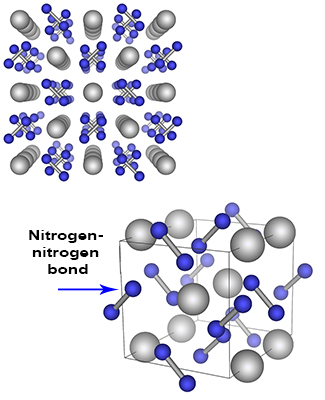
Titanium pernitride (TiN2), discovered by scientists at the EFree EFRC, is one of these exciting new metastable materials. This metal pernitride marks both the first non-noble metal pernitride and the lowest density metal pernitride synthesized to date.
The material’s most interesting feature is found in the single bond between two nitrogen atoms (nitrogen-nitrogen, or N-N) within the structure. The bond makes the material highly resistant to external pressure (only 18 percent less effective compared to diamond). This property makes the material useful as a hard coating for cutting and drilling applications.
Additionally, N-N stores large amounts of chemical energy. If ignited, this energy can be released from this metastable material to form highly stable molecular nitrogen (N≡N) and titanium, the highly stable, lowest energy minimums. Because of this, scientists may consider TiN2 as a future energetic material for use in explosives with some modifications to the material.

Scientists at CNGMD have been investigating new metastable tin nitride (abbreviated SnxNy) materials. Recently, they synthesized Sn3N4 along with the unexpectedly higher energy, SnN1-δ. Both materials exhibit both semiconductor and metal characteristics. An energy gap, known as the band gap, between the excited and stable energy levels for the electrons in the metastable, semiconducting S3N4 and its moderate free electron concentration makes it an interesting candidate for use in solar water splitting cells. In solar water splitting cells, the sun’s energy breaks down water into energy sources such as hydrogen fuel or electricity. The team tested Sn3N4 for this application and found it showed a moderate ability to produce an electric current when irradiated by light. With the addition of silicon, germanium, tin variants such as in SnN1-δ, or other elements, the activity of Sn3N4 can be tuned to better carry out this reaction.
In summary, the field of metastable metal nitrides is at the tip of the iceberg. Scientists have created a variety of exciting materials. These materials share the high incompressibility of their predecessors useful for hard coatings. They offer new realms to explore beyond their possible future usage in explosives, electronics, light-driven reactions, solar cells, and more.