In modern electronics heat can be both a problem and a benefit. Maintained heat can be used to generate electricity; while in electrical circuits, the goal is to get rid of heat quickly. These two processes can be used together to power new electronics while keeping them cool.
“Electronic devices are becoming smaller and faster,” said Alexander Balandin, an Associate Director and one of the principal investigators of the Center for Spins and Heat in Nanoscale Electronic Systems (SHINES). “Devices of all types generate heat as a byproduct, and you have to remove this heat efficiently and fast.” Balandin and his coworkers at SHINES are inventing new experimental and theoretical ways to understand the fundamental processes that govern heat transport in solids.
Heat in solids is carried in small packets of energy called phonons. Like their electromagnetic sibling, the photon, a phonon is a wave that also exhibits characteristics of a particle. Like a billiard ball on a pool table, the phonons can collide with the cushions, or boundaries, of a crystal and be scattered in different directions. This boundary scattering makes it difficult for heat to move through solids, which is known as thermal resistance. However, Balandin’s team has shown that boundary scattering is not the only effect the phonons experience.
Balandin explained, “In very small structures, you introduce not only the boundary scattering, you can also change the properties of phonons themselves. If you take a really tiny slice of material, its natural vibration changes, and thus the phonon properties themselves change.” This effect is known as phonon spatial confinement.
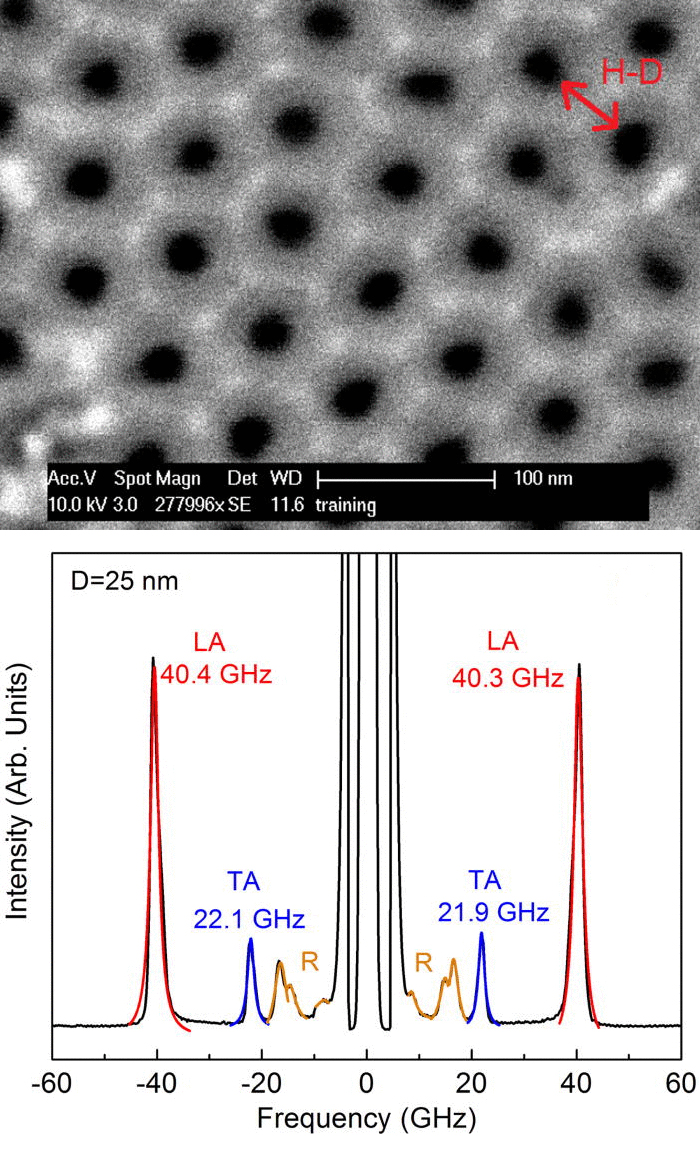
To show phonon spatial confinement experimentally, the SHINES team used thin films of alumina with nanometer-scale pores. These pores are so small that they would have to be 1,000 times larger to fit a single human hair through them. Each film had a porosity, or pore volume, of 13 percent but with different pore diameters. The pores were 25, 40, and 180 nanometers wide. The constant porosity was important because samples of the same material, with the same porosity, should have the same ability to transmit heat, otherwise known as thermal conductivity.
However, the researchers found that at these pore diameters, the thermal conductivity decreases because of boundary scattering and phonon spatial confinement. The team observed that the frequencies of acoustic phonons – the main heat carriers in this material – have been transformed from a typical bulk phonon spectrum to one revealing phonon confinement effects. In other words, instead of observing a wide range of phonon signals, only individual peaks of phonons were observed. This is the first time that phonon spatial confinement has been observed experimentally at these length scales and correlated with heat conduction.
Wasted heat in electronics and energy production has been a basic obstacle in the engineering community. This research is working to change that by allowing scientists to tune heat fluxes at the nanometer scale. Balandin and his team are applying what they have learned in nanoporous films to other materials, such as nanowires and magnetic films and ribbons, in the hope of someday designing materials based on the thermal needs of the device. Ultimately, this work may someday lead to much more efficient energy generation and allow the continuing development of smaller and faster computer chips.