
Over 3 million tons of phthalic anhydride are produced annually for the manufacture of plasticizers, unsaturated polyesters, and alkyd resins for use in plastics, fabrics, and paints. Unfortunately, this chemical is almost exclusively produced from petroleum, the consumption of which is associated with well-known environmental and political drawbacks. Producing aromatic compounds renewably from biomass is challenging, but researchers at the Catalysis Center for Energy Innovation (CCEI) have overcome several hurdles in the production of phthalic anhydride from biomass.
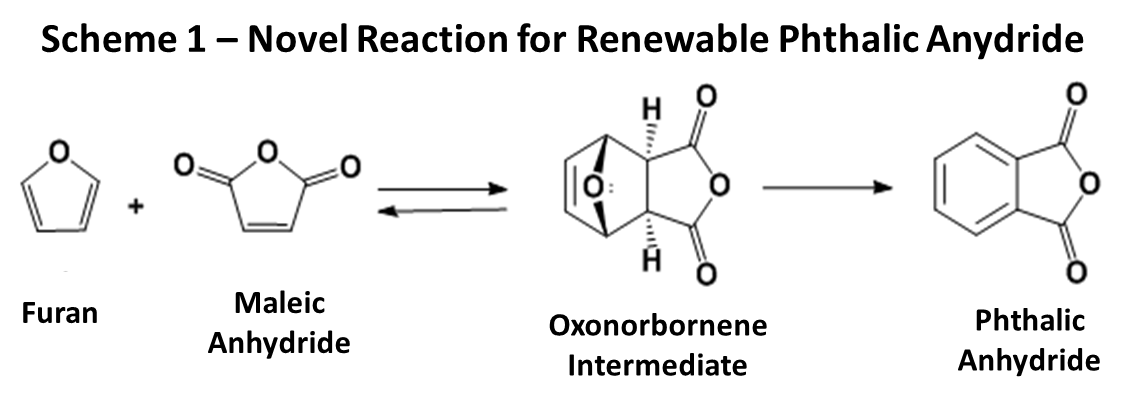
Two compounds produced from biorenewable sugars, furan and maleic anhydride, can react to produce phthalic anhydride. The reaction occurs in two steps: a Diels-Alder reaction to form an intermediate, followed by a dehydration reaction (Scheme 1). When the Diels-Alder reaction occurs, energy is released, increasing the temperature of the reaction mixture. This can be dangerous, because reactions happen faster at higher temperatures, and heat-producing reactions can accelerate and run away if not carefully controlled. However, this system has a built-in safety mechanism: if the temperature gets too high, the backwards reaction to the reactants is favored, and the reaction slows down.
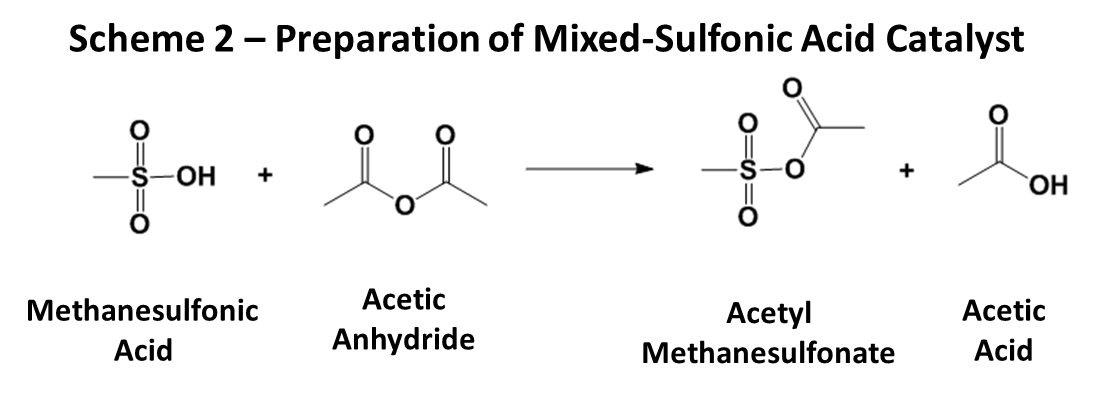
The intermediate (oxonorbornene), in turn, forms phthalic anhydride at high temperatures and acidic conditions. However, competing reactions make a polymer that contaminates the products and reduces yield. The same reactor environment that promotes dehydration also promotes the formation of side products. To work around this challenge, the researchers at CCEI developed a molecular dehydration that does the job of a traditional acid without promoting polymerization. By combining methanesulfonic acid with acetic anhydride (Scheme 2), a mixed-sulfonic carboxylic anhydride is produced. By just using methanesulfonic acid, the yield to the products is only 11% because of undesirable side products. By using the carefully engineering mixed-sulfonic carboxylic anhydride, 80% yield was achieved.
Another attractive feature of the first reaction is that no solvent is used. Without the need for a solvent, energy and cost can be saved by reducing downstream separation costs and eliminating the need to clean up and recycle a solvent stream—making this “green” reaction even greener. By engineering new routes to renewable chemicals, we are getting closer to a more sustainable world.