The sun provides energy; if plants can trap it, surely we can as well. This simple idea still faces many challenges to implementation, but one promising solar energy-generating device is a type of solar cell called a dye-sensitized solar cell (DSSC).
DSSCs have drawn attention because they avoid the high processing costs required to make traditional solid-state semiconductor photovoltaic cells, such as those made of silicon. Although DCCSs and related solar cells include expensive materials (ruthenium is a common component in the dyes; platinum is a common cathode material), the roll-to-roll techniques used to make DCCSs and their flexible construction lowers manufacturing and installation costs, making DSSCs attractive alternatives to traditional solar cells.
DSSCs generate electricity through reactions at an interface where dyes in a liquid electrolyte are attached to a surface by a chemical linker known as an anchor. The dyes absorb light, exciting electrons that then move through the anchor into an anode typically made of relatively cheap titanium dioxide. Recently, work has been done trying to convert standard DSSCs into artificial photosynthesis cells to store energy in chemical bonds for later use. This is attractive as a load-leveling strategy and for provision of a non-fossil fuel. However, extending the techniques used in DSSCs to split water has proven difficult, and one key problem has been the instability of the dyes.
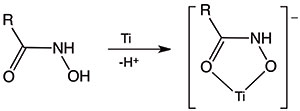
Researchers at the Argonne-Northwestern Solar Energy Research (ANSER) Center have suggested improved anchors for attaching both ruthenium as well as organic dyes to titanium dioxide anodes. Inspired by work in pharmacological and bioinorganic studies, the team of researchers led by Schmuttenmaer, Batista, and Crabtree published their findings in Inorganic Chemistry. The team found that hydroxamic acids worked well as anchors in traditional DSSC applications, but were also more stable than other anchors when used in artificial photosynthesis cells.
More than simply finding novel dye-anchor chemistry, the researchers carefully studied why hydroxamic acids worked better. The team constructed cells that included dyes with different anchors, measured cell efficiency and considered each part of the cell as a component in a model circuit. From these experiments, the team deduced that the hydroxamate group formed a more stable bond with the TiO2 anode surface, was a better electron conductor, and blocked electrons from returning to react with the dye and water, compared to previously researched anchors.
"The new anchor is more firmly held than traditional anchors, and the full cell thus has better resistance to cell degradation by humidity," Crabtree noted.
Because of the group's broad synthetic capabilities and careful control experiments, they were able to explore not just what makes an improved dye anchor, but why. Study of such structure-function relationships are central to the Energy Frontier Research Center's mission and help predict new strategies for improvements in adapting DSSCs for artificial photosynthesis.
"Hydroxamates, as yet relatively little studied, may have future promise for applications other than DSSCs, for example, in the synthesis of catalysts and their attachment to TiO2 nanoparticles for easy catalyst recovery," Crabtree added.