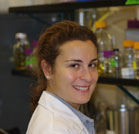
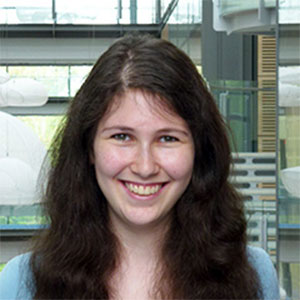
Dina Sharon, an undergraduate student in John Groves' lab at Princeton University, has received a Fulbright U.S. student award, a highly competitive, merit-based grant for international educational exchange for students, scholars, teachers, professionals, scientists, and artists. She has chosen to use her award to travel to Israel for a year and continue her scientific pursuits in computational chemistry working with Sason Shaik at the Hebrew University of Jerusalem. Sharon worked with Groves at the Center for Catalytic Hydrocarbon Functionalization (CCHF) to develop computational approaches to study how to activate the carbon-hydrogen bonds of small molecules found in natural gas, such as methane and ethane.
As Sharon explained, "Carbon-hydrogen bonds are ubiquitous but often inert. If they could be activated, they would represent a valuable starting point for fuels and for the construction of chemical building blocks."
Working with Shaik, Sharon will continue to explore this research area. In Israel, she will study an enzyme called SyrB2 that makes carbon-chlorine bonds from carbon-hydrogen bonds. She will use quantum- and molecular mechanics to study the enzymatic reaction, with the final aim of further understanding and enhancing SyrB2 selectivity. Her results will have significance in energy research and in medicinal chemistry, because carbon-chlorine bonds represent starting points from which many other kinds of molecules can be made.
Sharon attributes part of her success to the training she has received at CCHF, a U.S. Department of Energy-funded Energy Frontier Research Center (EFRC). The collaborative nature of the Centers, in particular the CCHF, has connected Sharon with other computational chemists, such as Daniel Ess at Brigham Young University, Tom Cundari at the University of North Texas, and William A. Goddard at CalTech.
"I have seen firsthand how collaboration breeds synergy," said Sharon. "Being seen not as a student, but as a researcher, has helped develop my scientific maturity. I am so grateful to my EFRC collaborators for teaching me about chemistry and the importance of working together to address challenging problems."
Sharon believes her experience in the CCHF fostered both her curiosity about specific scientific concepts and her enthusiasm for research. “Without energy, society would be at a standstill, and there is a need to determine new practical sources of energy,” Sharon said. “I am inspired to be included in a group which studies how we will sustainably heat our homes, power our cars, and generate the electricity humanity needs.”