
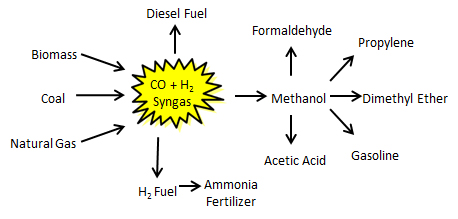
One promising route for producing a variety of fuels and chemicals from biomass involves synthesis gas, or syngas. Syngas is a mixture of hydrogen (H2) and carbon monoxide that can be produced from biomass or fossil fuels. In a biomass gasifier, feedstocks such as wood or crop residues are partially combusted at around 1,000°C, producing mostly syngas but also containing sulfur and tars that need to be removed. A large portion of the processing cost of turning biomass into fuels is the cleanup of syngas. These impurities are notorious for poisoning downstream catalysts, blocking filters, damaging engines and turbines, or having detrimental effects on fuel cells. An ideal cleanup system would adsorb the sulfur compounds, usually H2S, without cooling down the syngas too much, as it would just need to be reheated for further processing, and then break down the tars and any unconverted fuel into more syngas. The challenge is to find materials that can perform and remain stable at these extreme temperatures.
At the Center for Atomic-Level Catalyst Design, an Energy Frontier Research Center (EFRC), center director Jerry Spivey with colleagues from Louisiana State University and Pennsylvania State University have combined catalyst synthesis, characterization, and computation to design ceria-based materials that clean up the output of a biomass gasifier. This work has generated materials that remove H2S and catalyze the reforming of the tar impurities. They started with rare earth oxides, which have a reputation for stability at high temperatures, reasonable sulfur absorption capacities, and activity for hydrocarbon oxidation. By adding small amounts of iron or manganese to these oxides, the researchers synthesized new catalysts that exhibited higher sulfur tolerance and better coking resistance (where the catalyst is deactivated when black soot accumulates on it) than the nickel-based catalysts typically used to break down tars or similar hydrocarbons at high temperatures.
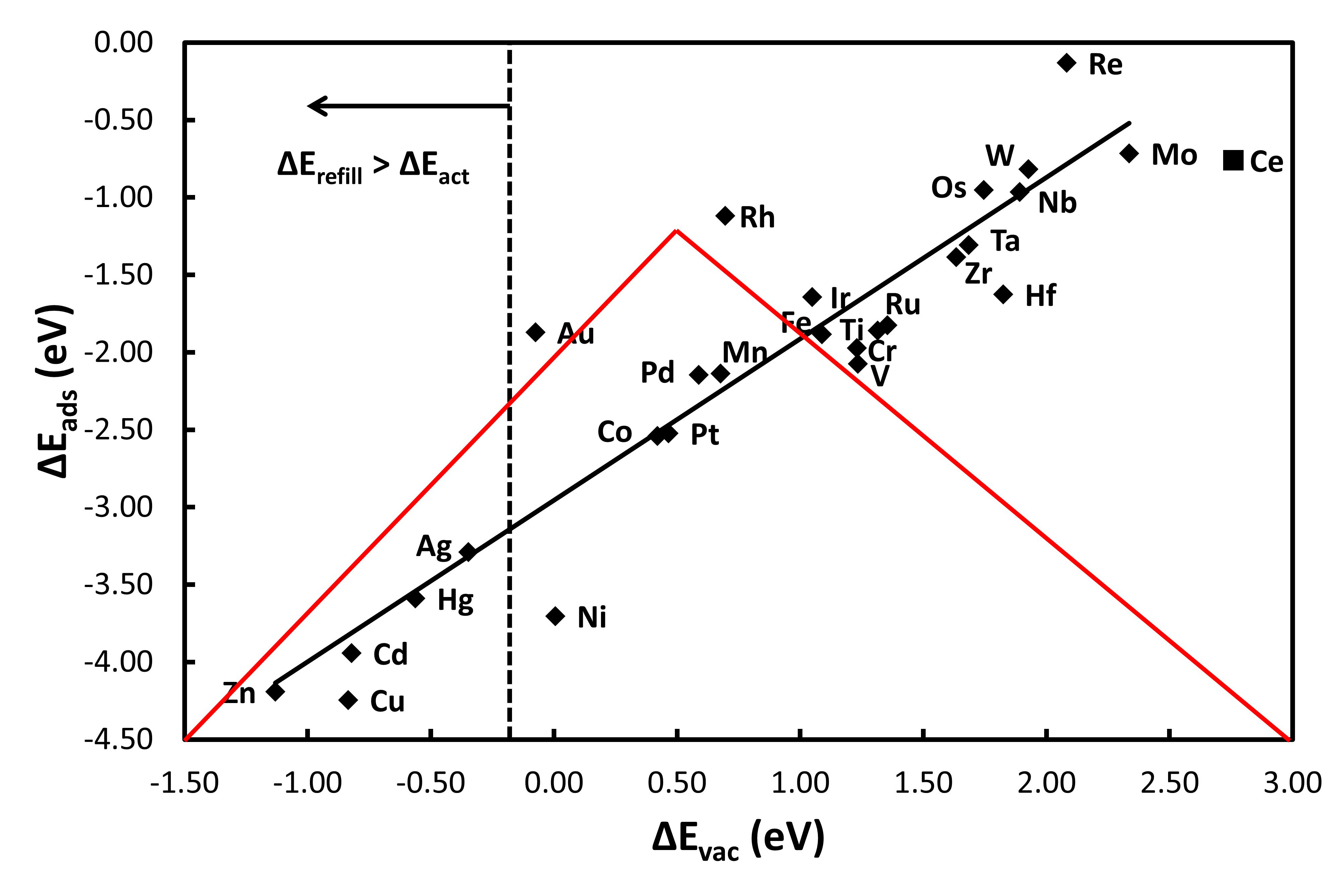
Insight into the underlying chemistry was needed to optimize the design of these catalysts. Using computational chemistry to screen dozens of elements from the periodic table, they predicted a volcano curve that peaks at the optimum conditions. The optimum metals to add to the ceria were predicted to be rhodium, platinum, and palladium (expensive and rare metals), as well as iron and manganese (cheap and abundant).
After synthesizing the new catalysts, they tested the long-term performance by exposing them to a "dirty" stream of syngas, H2S, and a model tar compound, to simulate what the catalysts would experience in a commercial gasifier. While H2S and tar would completely deactivate a typical nickel-based catalyst, the new catalysts lasted longer and were only partially deactivated; they continued to reduce the tar in the stream long after the nickel-based catalyst would have been deactivated. Moreover, after being deactivated by H2S, the new catalysts could be regenerated and recycled.
"This project exemplifies the synergy that results when people like Mike Janik at Penn State and Kerry Dooley at Louisiana State focus their different skills on a challenging problem," said Spivey. This project shows how computation can be used to explain observed material performance, predict improved performance, and guide synthesis of improved catalytic materials. Collectively, the development of new materials was facilitated by direct integration of computation, synthesis, and characterization efforts enabled by the EFRC framework.