
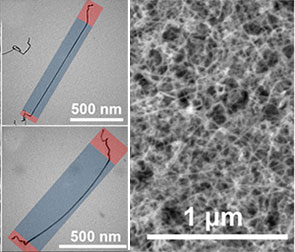
More efficient solar cells, longer-lasting batteries, and faster computers could all be possible with parts designed with nanostructured materials, small building blocks with sizes less than the wavelength of visible light. Unfortunately, these materials are often made of exotic compounds, or are cost and energy prohibitive to manufacture in large quantities. In particular, engineers and scientists are interested in nanosized semiconductors made from silicon and germanium, which are earth abundant. Researcher Xiaotang Lu and her advisor Brian Korgel at the University of Texas at Austin Energy Frontier Research Center Understanding Charge Separation and Transfer at Interfaces in Energy Materials, recently discovered a simpler way to make silicon and germanium nanowires and nanorods.
Although silicon and germanium are earth-abundant materials, their use in synthesizing nanosized building blocks, such as nanorods and nanowires, often proves difficult. For example, current methods usually involve very high pressure reactors, which take a long time to turn over quantities large enough for manufacturing and can involve toxic and explosive gases. Further, conventional methods of making nanowires and nanorods involve reactive and unstable precursors of gold, bismuth, or tin nanoparticles. The result is that silicon and germanium nanowire syntheses are often very sensitive to small changes in reactant purity or age, making them costly and hard to scale.
Lu and Korgel have developed a method with fast turnover, using a single-step reaction and reactants in a single vessel. In some cases, the reactions only took 10 minutes. The method also offers control over length, allowing for the production of nanorods that are 25 nanometers to about 1000 nanometers long with approximately the same diameters.
The result is a method for making nanostructures with highly tunable optical and mechanical properties, for applications in solar cells, batteries, and next-generation sensing and computing devices.