Molecules and ions behave strangely when they get into tight places. The researchers at the Fluid Interface Reactions, Structures and Transport (FIRST) Center are studying how molecules and ions move through tight spaces and how to design "highways" that increase the speed of ions. They found that nano-sized tubes, 1,000 times smaller than a strand of hair, act as molecular highways that can increase the power of energy storage devices.
Allowing ions to travel faster is important for high power density devices, such as supercapacitors. These devices allow for rapid storage and use of electric power. They do this by storing electric charge at the solid-liquid interface of high-surface-area porous carbon electrodes.
Porous carbon electrodes have a collection of pores with widths from microns down to sub-nanometers, smaller than the width of a single DNA strand. Previous efforts in the FIRST Center showed that decreasing pore width increases the amount of energy that the pore can store. However, as pores become nano-sized, decreasing the pore size produces erratic results; the stored energy can either increase or decrease. This effect lasts until the pore becomes 10,000 times smaller than a strand of hair. That is, the charge storage capacity drastically increases when the pores act as nano-cages just a little bigger than the "trapped" ions.
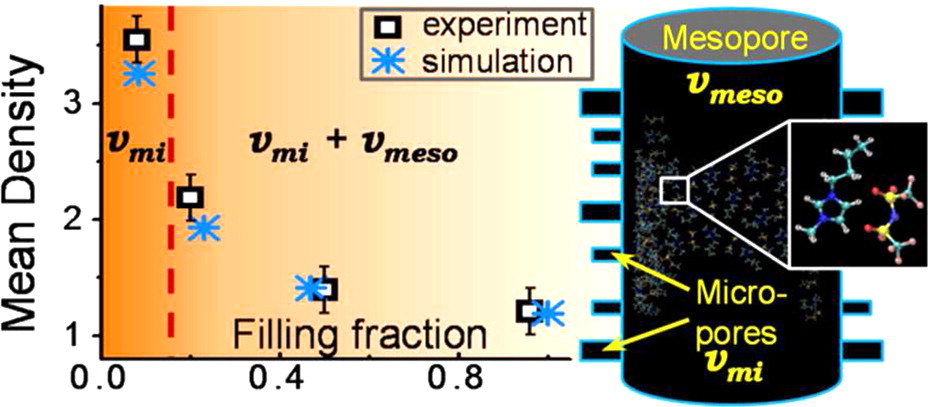
Leo Bañuelos and co-workers at the FIRST Center have studied the dynamics of room-temperature ionic liquids within the carbon electrode's nanometer-sized pores and how those dynamics can affect the storage of electric charge. Few techniques allow probing the average structure and motion of molecules and ions at the nanometer and sub-nanometer scale within samples containing pores of different sizes. With this in mind, Banuelos and co-workers turned to the Spallation Neutron Source at Oak Ridge National Laboratory to probe the structure and dynamics of the ionic liquids within the meso- and micro-pores.
Mesopores are pores between 2 and 50 nanometers—a few hundred ions in diameter. Micropores, however, are less than 2 nanometers. In other words, ions within micropores are confined in nano-sized cages.
"Small angle neutron scattering allows us to see inside optically impenetrable nanometer-size porous materials and find out how ionic liquid ions are reorganized under confinement," explained Banuelos. "Then, using neutron spin echo spectroscopy, we were able to measure ion dynamics throughout different regions of the hierarchical porous carbon." The researchers also used computational modeling to simulate how ionic liquids are arranged near the pore walls and how the ions move throughout the pores.
They found that the carbon surface disrupted the ionic liquid bulk structure within the slit-like micropores, while the larger mesopores acted as molecular highways allowing ions to quickly enter the micropores. Once contained within the micropores, the speed of the ions decreased; however, the nano-cages allowed the ions to store more energy.
This study showed how neutron techniques at facilities such as the Spallation Neutron Source and the Center for Neutron Research at the National Institute of Standards and Technology can be used to track molecular motion within carbon electrodes and drive the design of improved energy storage materials.
Banuelos went on, "The best electrodes for supercapacitors must have large 'highways' [mesopores] for fast ion transport to the high energy storage sites [nano-cages]. These results help unravel the structure and dynamics, across several length and time scales, of an electrolyte inside a real electrode material."