

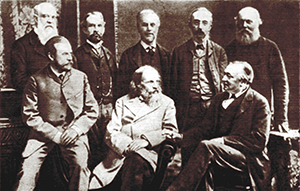
When we look to the past and follow the history of scientific progress, a pathway of incredible cultural diversity is revealed. For centuries, the progress of science as a whole has relied on effective communication between scientists around the globe. By the 1800s, international communication among researchers had already become commonplace. For example, Dmitrii Mendeleev delivered lectures on his work on the periodic system all across Europe, eventually becoming professor at the Saint Petersburg Technological Institute in Russia, an elected member of the Royal Swedish Academy of Sciences, and a recipient of the Davy Medal from the Royal Society of London. Likewise, early American scientists such as Benjamin Franklin, Josiah Gibbs, and Albert Einstein all used international meetings as a way to share their results and improve upon their research. Similar international partnerships are playing a key role today at the many Energy Frontier Research Centers (EFRCs), where scientists are working on U.S. Department of Energy-funded projects to tackle grand challenges in energy science.
At EFRCs all around the country, international partnerships are making an important contribution to high-quality research by keeping U.S. scientists at the forefront of progress in their fields. Jeffrey Long, director of the Center for Gas Separations Relevant to Clean Energy Technologies (CGS), points out, "The foremost experts in numerous areas are not all in the U.S. Learning from world experts how to collect and analyze certain types of data, while also seeing the differences in culture of how labs in other countries function, has provided valuable experiences for graduate students and postdocs working at EFRCs."
At the Center for Emergent Superconductivity (CES), collaborative work between Peter Johnson's group and Uwe Bovensiepen, group leader of the ultrafast physics group at the University of Duisburg-Essen in western Germany, has revealed how lasers can be used to alter the effective number of electrons in high-temperature superconductors and change the effective mass of those electrons. This research represents an important step in understanding the physics behind high-temperature superconductor materials that can be used to fabricate efficient energy generation, transmission, and storage devices.
Jonathan Rameau, assistant physicist within the group, describes how both teams shared their unique skills: "Because our respective groups' expertises were rather different, I was able to learn a great deal from them about two photon angle-resolved photoemission spectroscopy, while I brought my experience with the one photon technique to the table." Their teamwork resulted in an article in Physical Review B describing the new technique. The team is currently using their findings to resolve key aspects underlying the origin of high-temperature superconductivity in copper oxides.
For Elizabeth O'Malley, senior advisor for international programs within the Office of the Deputy Director for Science Programs, the importance of international collaborations comes down to doing the best science. "It's important to make sure you're finding the best out there. If you're only working within your borders, or within your company, you're just not going to be doing the best science." She also explains how international partnerships bring diplomatic benefits. "Most often both countries stand to gain something (i.e., research funding), and working towards a common goal helps develop strong relationships between administrations in the U.S. and those in other countries."
The significance of international partnerships within EFRC research can be seen through the many examples of groups collaborating with foreign research teams. At the Integrated Mesoscale Architectures for Sustainable Catalysis (IMASC) led by Harvard University, researchers are collaborating with the Fritz Haber Institute in Berlin as well as the National Research Council in Rome in pursuit of more energy-efficient methods for production of industrial chemicals. Scientists at the Argonne Northwestern Solar Energy Research Center (ANSER) have an ongoing exchange with researchers at the Delft University of Technology in the Netherlands to study the electronic properties of new perovskites for solar cell applications. Oliver Monti at the Center for Interface Science: Solar Electric Materials (CISSEM) has worked with several groups in Germany on projects focusing on inorganic/organic interfaces within organic solar cell devices, helping to improve device efficiencies and bring the low-cost technology closer to maturation. The list goes on.
The best science is only achieved when great minds from different backgrounds work together, a viewpoint that is manifested throughout the many EFRCs. The benefits of international partnerships within the EFRCs are threefold: 1) the knowledge and technical expertise of foreign leaders translates to improved quality of U.S. research, 2) cross-cultural experiences provide a mind-opening perspective for young scientists regarding scientific approaches and laboratory cultures, and 3) international collaborations act as a diplomatic bridge between the U.S. and foreign administrations.
In the pursuit of knowledge, science supersedes cultural boundaries. Research at the EFRCs continues to excel because of these wonderful international partnerships.