The need for greater energy generation has contributed to a surge of interest in fuel cells and other fossil fuel-free energy technologies that are driven by electrocatalysts. An electrocatalyst provides an efficient means to interconvert between different kinds of energies, such as electricity and hydrogen fuel. Studies of such catalysts have frequently been carried out in systems where all components are dissolved in a single liquid phase. It is easier to study catalysts in liquids, allowing chemists to efficiently evaluate the designed properties of a large number of potential candidates. But, these systems are often limited in their real-world applications. James Mayer from Yale University and his colleagues at the Center for Molecular Electrocatalysis (CME) took on the challenge of a solid catalyst and found that the performance depends on the organization of the surrounding environment.
In this case, the catalyst turns oxygen into water, a reaction known as oxygen reduction, half of the reaction that a fuel cell needs to carry out to produce electrical energy without using fossil fuels. Competing with this desirable reaction is a deleterious reaction that forms hydrogen peroxide. Minimizing this reaction is an important feature in selecting a viable catalyst.
The team worked with five iron-based catalysts, known as iron-porphyrin complexes. Some of the designs incorporate proton relays, which deliver positively charged protons to (or from) the active site of a catalyst. The complexes were immobilized using three different thin-film techniques commonly used in electrocatalytic fuel cell studies. The immobilization technique changed the mesoscale environment, which is between 1,000 nanometers and a few millimeters around the catalyst.
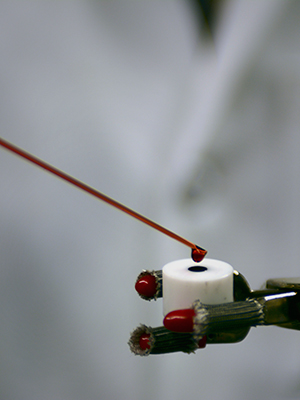
The team evaluated the catalysts for the ability to selectively carry out the desired oxygen reduction reaction. They found the catalysts with more proton relays produced less of the undesirable hydrogen peroxide when an ink of the catalyst was drop cast onto a glassy carbon electrode.
Michael Pegis, a graduate student at CME and co-author, said, "From a practical standpoint, we must broaden our gaze into the mesoscale environment surrounding the catalyst. Hopefully our conclusions for oxygen reduction can be useful to groups looking at other important electrocatalytic transformations."
The conclusion of this investigation is that the nature of the deposition technique to create the film on which the catalyst rests has as substantial an impact on the catalysis as the catalyst structure itself. Still, in each case, the presence of potential proton relays gives as good or better selectivity than the compound without a relay.
The authors of this study suggest that future investigations of such catalysts use similar analyses of selectivity--looking at multiple mesoscale environments--to better understand catalysts' potential in functional devices. Developing adsorbed electrocatalysts will require understanding and control not only of the molecular properties of the catalyst but also the larger mesoscale structure of the whole catalytic process.