

Squeezing a chemical between two diamonds creates extremely strong threads to lift up energy technologies
Jennifer L. Esbenshade
Image

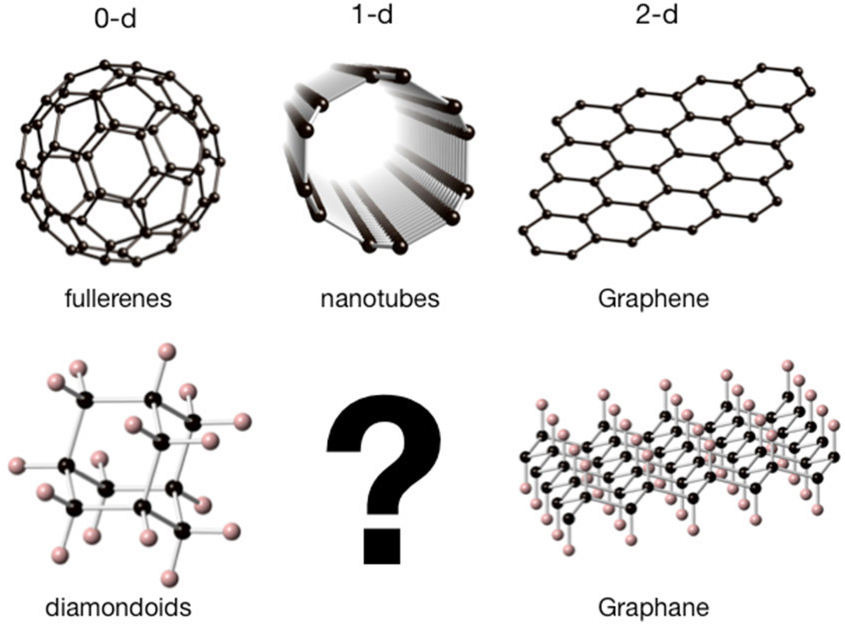
Various forms of carbon nanomaterials. Graphite-like carbons include (top) fullerenes, nanotubes, and graphene. Diamond-like carbons include (bottom) diamondoids (admantane) and graphane. The black and off-white spheres represent carbon and hydrogen, respectively. Carbon nanothreads are a new form of linear material in the diamond-like carbon row. Reprinted with permission from Badding et al. Copyright 2015 SPIE--John Badding and Vincent Crespi. Synthesizing Carbon Nanothreads from Benzene. SPIE Newsroom, 26 January 2015.

The use of extreme environments has filled a major gap in the world of carbon nanomaterials. By compressing the chemical benzene to 200,000 times atmospheric pressure--the equivalent of having 200 full-grown African elephants simultaneously standing on your big toe--and then decompressing it slowly, researchers in Energy Frontier Research in Extreme Environments (EFree) discovered small, extremely stiff, and strong threads. The nanothreads were made inside a Paris-Edinburgh press, a giant diamond anvil cell where the materials are pressurized between two diamonds. The materials have the potential to be used in batteries, solar cells, or other innovative technologies, such as space elevators, that require low cost, lightweight, and high-strength materials.

Nanothreads, similar to carbon nanotubes, are linear in shape. However, where carbon nanotubes exhibit a bonding structure similar to graphite, the nanothreads have a bonding structure similar to diamonds. This bonding structure can lead to great strength and stiffness. With the unique shape or dimensionality and bonding, nanothreads represent a new form of carbon nanomaterials that had previously been unobtainable.

“Theory suggests that nanothreads could have a strength equaling or exceeding that of carbon nanotubes, the strongest materials known to date,” said John Badding, who led this EFree research at Pennsylvania State University.

The material has gained a lot of interest from popular media, including BBC and CNN, for its fulfillment of Arthur C. Clarke's novel The Fountains of Paradise. In this novel, Clarke contemplates a “continuous pseudo-one-dimensional diamond crystal” for use in a space elevator, a theoretical form of transportation to space without the use of large rockets. While the idea of a space elevator is intriguing, there are many energy and transportation technologies here on earth that could benefit from such materials.

Future studies of this material will focus on changing the chemical composition of the nanothreads as well as searching for new microstructures. Changing the thread composition in just the right way could lead to tunable electrical properties. Altering these properties may lead to the development of new materials for solar power or light-emitting applications. In addition, researchers are working to reduce the pressure of the synthesis by a factor of 4 or 5 to make large-scale industrial production a possibility.

EFree not only supports work in developing new carbon nanomaterials, such as the carbon nanothreads, but strives to make fundamentally new materials and to use those materials for energy-based applications. They look to not only make new materials using extreme conditions but also to understand the fundamental formation of the materials and to find less extreme routes to make them.

More Information

TC Fitzgibbons, M Guthrie, ES Xu, VH Crespi, SK Davidowski, GD Cody, N Alem, and JV Badding. 2015. "Benzene-Derived Carbon Nanothreads." Nature Materials 14(1):43-47. DOI: 10.1038/nmat4088

Acknowledgements

This work was supported as part of the Energy Frontier Research in Extreme Environments (EFree) Center, an Energy Frontier Research Center funded by the U.S. Department of Energy (DOE), Office of Science, Office of Basic Energy Sciences (BES).

Facilities and instrumentation support was provided by the following. X-ray diffraction analyses were performed at the high-pressure collaborative access team (HPCAT) beamline 16 ID-B at the Advanced Photon Source (APS), Argonne National Laboratory (ANL). HPCAT operations are supported by DOE National Nuclear Security Administration and DOE BES, with partial instrumentation funding by the National Science Foundation (NSF). X-ray PDF analyses were performed at the X-ray Science Division (XSD) beamline 11 ID-C at the APS. The APS is a DOE Office of Science User Facility operated for the DOE Office of Science by ANL.

Sample synthesis was performed at the Spallation Neutrons at Pressure (SNAP) beamline and neutron diffraction analyses were performed at the Nanoscale Ordered Materials Diffractometer (NOMAD) beamline at Oak Ridge National Laboratory's (ORNL) Spallation Neutron Source (SNS). The work at SNS was sponsored by the Scientific User's Facility Division, BES, DOE. SSNMR characterization was performed in part at the SSNMR facility at Arizona State University (ASU). This facility is supported by the ASU Magnetic Resonance Research Center (MRRC). User fees were supported by NSF CHE 1011937. SSNMR measurements were also performed at the W. M. Keck Solid State NMR facility at the Geophysical Laboratory, Carnegie Institution of Washington. J. Neuefeind (ORNL), C. Benmore (ANL), G. Holland (ASU) and J. Yarger (ASU) performed neutron (ORNL), X-ray (ANL) and SSNMR measurements (ASU), respectively. S. Aro (Penn State), K. Li (Carnegie Institution of Washington) and J. Molaison (ORNL) assisted with synthesis. K. Wang and T. Clark of the Penn State Materials Characterization Laboratory (MCL) assisted with TEM measurements.

About the author(s):

Jennifer L. Esbenshade is a Ph.D. candidate studying materials chemistry under the advisement of Andrew Gewirth at University of Illinois at Urbana-Champaign. She is a member of the Center for Electrochemical Energy Science (CEES). Her research focuses on analyzing and modifying electrode surfaces in lithium-ion battery systems.

Newsletter Articles

Research Highlights