Sunlight, with its widespread and unlimited availability, is a promising renewable energy source. Yet the bottleneck for wider adoption remains its intermittent and often unpredictable supply. To overcome this obstacle, excess solar energy must be stored so it can be supplied when the sun is not out. Energy could be stored in batteries and in the form of fuels, such as ethanol and hydrogen. The science of batteries has advanced over the years; future success relies on making batteries cheaper, lightweight, and more efficient. On the contrary, the science of fuel production from solar energy is still in its infancy. Compared to batteries, fuels possess higher energy per unit of volume and can be transported in containers, making fuels a superior alternative to batteries for storing solar energy.
The Argonne-Northwestern Solar Energy Research (ANSER) Center, an Energy Frontier Research Center (EFRC), is conducting fundamental research to make solar fuel production economically viable. The groups led by George Schatz and Joseph Hupp recently demonstrated that metal-organic frameworks (MOFs) could be used for efficient fuel production, either using sunlight or with battery power.
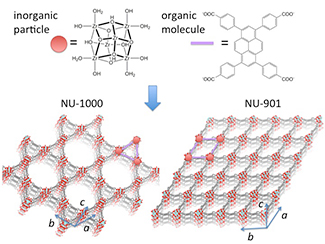
MOFs are crystalline materials consisting of metal atoms (or inorganic particles) connected to long, rigid organic molecules in a 3D network. A large number of different MOFs can be synthesized by varying these two components. Moreover, the structural design imparts high porosity to MOFs, a property highly desirable for chemical separation, gas storage, and fuel production applications. For the latter, the material should be electrically conducting. If solar powered, it must also allow light capture and energy transport.
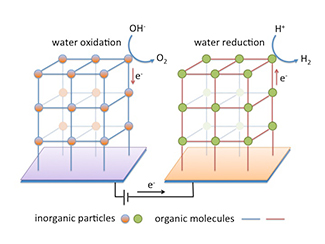
Any fuel-producing chemical cycle involves two processes. The process of oxidation involves removing electrons from chemical bonds of molecules, while reduction involves adding those electrons back. For instance, water molecules, each consisting of one oxygen atom and two hydrogen atoms, produce oxygen and hydrogen gases upon oxidation and reduction reactions. Hydrogen can be used as a fuel, while oxygen is a byproduct. The chemical that assists in these transformations is called a catalyst. The more catalyst available, the more fuel produced. The highly porous MOFs may provide an ideal support for catalysts, provided they allow flow of charge and energy through them. The device proposed by the ANSER team consists of different MOFs for oxidation and reduction processes. They are electrically connected, where sunlight or a battery can power the flow of electrons between the two.
"MOFs have traditionally been considered insulators, so the concept of electrical conduction in porous MOFs was not obvious at first," said Schatz.
His team performed a systematic computational study to determine the potential of MOFs for electrical conduction. They provided detailed analysis of two promising candidates, NU-1000 and NU-901. In addition to electrical conduction, the calculations take into account the compatibility of the material with the reaction mixture and electrical contacts. This inclusive computational approach will allow large-scale screening of more than 20,000 known MOFs, to identify suitable candidates for fuel production.
"It was challenging to perform this computational analysis on electrical conduction in MOFs, because very little is known on this subject," said Schatz. "We saw this as a rare opportunity, where our computational work would accelerate material discovery." The study is highly relevant for several other EFRCs interested in using MOFs for energy applications (see feature article), including fuel production.
Previously, Schatz and the ANSER team developed a method for screening MOFs for sunlight-induced energy transport and proposed new MOF architectures for maximum light capture and long-range energy transport. This work indicates that fuel production in MOFs can be powered by sunlight instead of a battery. The direct conversion of sunlight to fuels could be more efficient than conversion and storage of solar energy into a battery followed by battery-powered fuel production.
In an alliance with theorists, the experimental team led by Hupp at ANSER constructed two concept devices that produce hydrogen and carbon monoxide fuels. For the former, their goal was to decorate NU-1000 with hydrogen-producing catalysts. Surprisingly, they observed that the catalyst settled at the bottom of the MOF instead. They discovered that the enhanced hydrogen-producing activity resulted from the favorable chemical environment in the MOF pores near the catalyst layer.
"The ability of the MOF to alter the environment proximal to the surface of the catalyst layer is key to achieving enhanced activity and minimizing energy loss for hydrogen generation," said Hupp. "We are optimistic that this idea, which has precedence in biological processes as well as in MOF-based materials, will prove useful in ongoing work on solar fuels catalyst development."
In closely related work with external collaborators, the Hupp team capitalized on MOF conductivity and stability to demonstrate that frameworks of appropriately selected organic molecules can be deployed to convert carbon dioxide to carbon monoxide, the simplest reduction product that can be used directly as a fuel.
"The union of theory-driven discovery and materials synthesis described here is just one of many powerful examples of how EFRCs, such as the ANSER Center, can accelerate transformative research by integrating multiple investigators to solve a common challenge," said Dick Co, ANSER Center Director of Operations and Outreach.