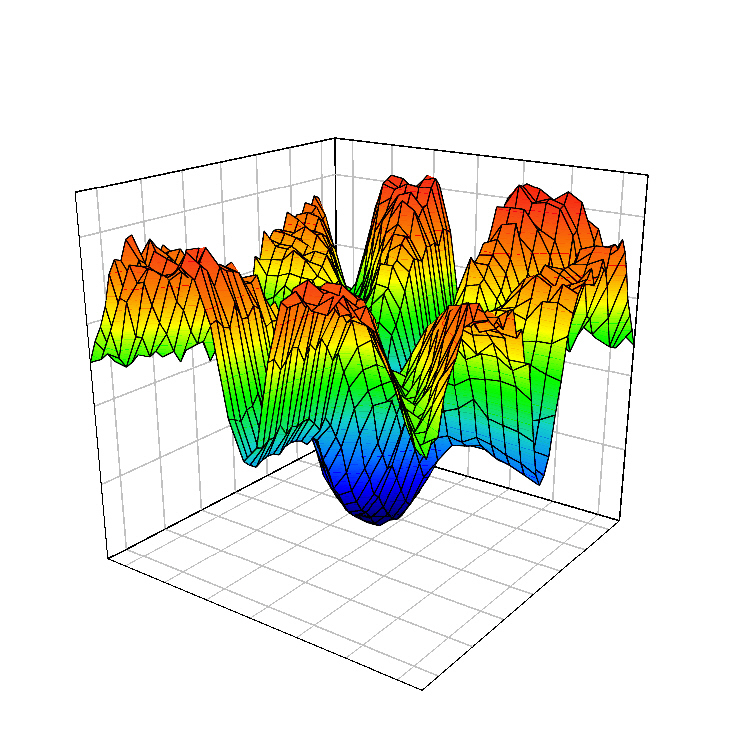
Safe operation of nuclear power plants demands structural materials that can resist severe radiation damage. While alloy development has made great progress over the past several decades, fulfilling the requirements of next-generation reactors remains challenging. Current alloy-design strategies usually attempt to trap defects by modifying the microstructure; however, the scientists in the Energy Dissipation to Defect Evolution (EDDE) Center are taking a different approach. They believe that modifying the compositional complexity of alloys could be a new path to enhance radiation tolerance.
In nuclear reactors, energetic particles deposit energy on the material, knock atoms out of their original positions, and create defects. While most initial point defects recombine and are healed, the surviving ones accumulate, migrate, and may form various defect clusters. These defects eventually compromise the material’s properties, making them, for example, brittle and swollen.
Although numerous types of alloys have been developed over thousands of years, most have only one principal element, such as iron in stainless steel or copper in bronze. Scientists at EDDE, however, are focused on an intriguing new family of alloys. These alloys contain two to five principal elements rather than one, with equal or near equal atomic concentration, while still maintaining a simple structure. What makes the alloys unique is that although macroscopically the atoms are approximately orderly aligned, each atom in these alloys has different neighbors, a different chemical environment, and is displaced from the perfect lattice position by a small amount. These alloys have exceptional mechanical properties and large application potential; however, their irradiation response remains relatively unknown.
One of the EDDE team’s hypotheses is that the disorders brought about by large compositional complexity can modify the material’s intrinsic physical properties, affect energy dissipation, and ultimately change the production and evolution of defects.
To test the theory, they first compared the transport properties of the compositionally complex alloys with those of pure nickel or simple alloys from both a theoretical and an experimental perspective. Their calculations found that the large compositional complexity not only breaks the perfect periodicity of electronic structure, but also brought in strong magnetic disorders, especially when certain elements, such as chromium, were added. Thus, the electrons in such complex alloys were expected to be more strongly scattered.
The prediction was strengthened through experimentation. They found that the measured electrical resistivity of the alloys with large compositional complexity was much larger than that in pure nickel, and consequently, the heat dissipated slower and stayed more localized in these complex alloys.
The scientists at EDDE further demonstrated that the modification on the intrinsic energy dissipation process affected the defect production and evolution in these complex alloys. Experimental analyses indicated that large compositional complexity could suppress the defect production and delay defect evolution. By observing the differences in the defect range and defect structure between the materials, the scientists discovered that the defect migration in the alloys was slower than in pure nickel. Simulation results suggest that the defects produced in the compositionally complex alloys are smaller and fewer than in nickel, which mirrors the experimental results.
Higher complexity does not equal more elements. The EDDE team realized that finding good combinations of different elements that can introduce certain local disorders might be more important than merely putting more elements together.
The EDDE scientists believe that, while just beginning, they are expanding the strategies to make structural alloys more reliable in a radiation environment, thereby improving the safety of nuclear power plants. Yanwen Zhang, director of the EDDE Center, said, “We are trying to bring new insights of energy dissipation and defect evolution that may inspire new design principles of radiation-tolerant structural alloys for advanced energy systems and for new defect engineering paradigms benefiting broader science and technology.”