
Effective catalysts are critical for developing efficient and clean chemical processes in industry. Numerous experimental and computational techniques are used to design better catalysts, but in many cases, we were beaten long ago by nature, which has been refining catalysts for life-sustaining reactions for billions of years. Many of the reactions that occur in a leaf are more efficient than those in our best chemical plants! Rather than starting from scratch, researchers at Department of Energy-sponsored Energy Frontier Research Centers have been looking to biological systems for inspiration as they press the boundaries of the state-of-the-art technology.
Using Nature’s Legacy for Solar Hydrogen: For billions of years, plants have converted the energy in sunlight into chemical energy via photosynthesis. Mimicking photosynthesis in an artificial process is the mission of the Center for Bio-Inspired Solar Fuel Production (BISFuel). A team of researchers led by Giovanna Ghirlanda at Arizona State University developed a new protein-based catalyst for producing hydrogen fuel from water and sunlight. This new catalyst is an artificial enzyme designed using insight from natural enzymes found in hydrogen-producing bacteria. Many of these bacteria have enzymes with a complex that contains two iron atoms as the active site for the reaction. The researchers synthesized an artificial amino acid (amino acids are the building blocks of proteins) that coordinates a similar active site. Then, they incorporated this amino acid into a test protein and demonstrated its performance as a catalyst for hydrogen production. The technique they used would allow them to incorporate this active site into any peptide sequence, opening the door to huge opportunities for designing proteins that optimize this reaction, and incorporating this reaction in a more complex reaction network.
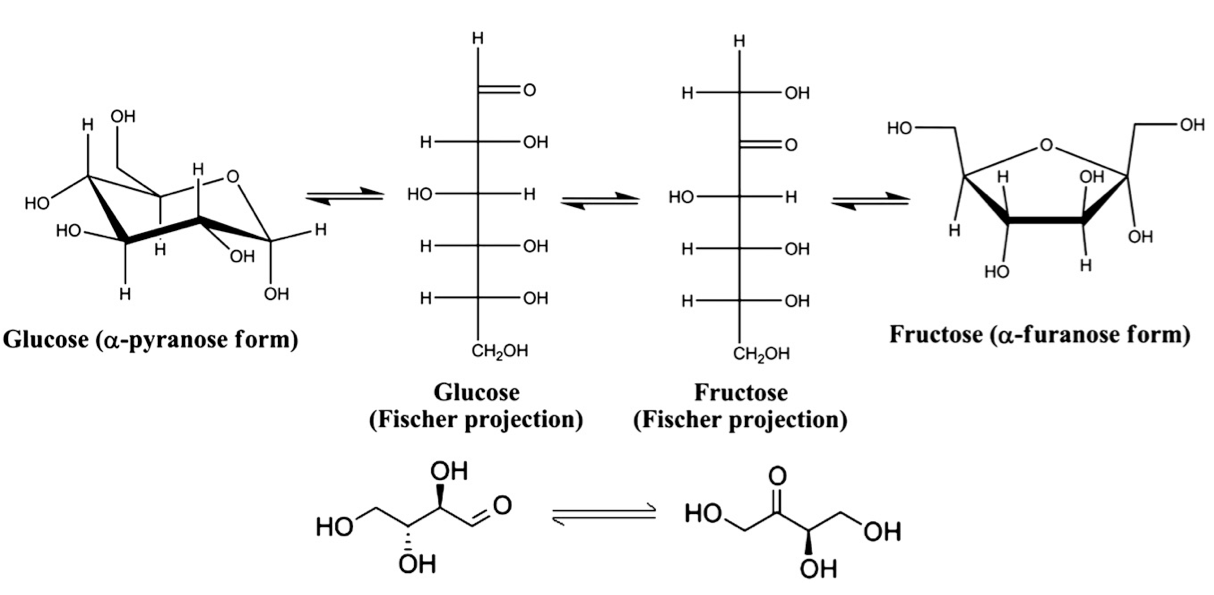
Mimicking Nature’s Enzymes to Rearrange Sugar Molecules: Artificial photosynthesis is far from the only example where scientists are drawing inspiration from nature. For example, scientists can harness plant’s “biomass” by transforming it into useful products, such as chemicals, polymers and fuels. An important step for this to occur is the isomerization of sugars, particularly the isomerization of glucose to fructose, because fructose is closer in structure to many desirable renewable products. Isomers are molecules that share the same atoms but are structurally different (see Scheme I showing the isomerization of glucose to fructose). This reaction is traditionally carried out using an enzyme such as D-xylose isomerase XI that has metal atoms embedded in the protein structure. Although enzymes such as these are routinely used in industrial processes, they are limited to specific reaction conditions, are costly and have limited lifetimes.
Ideally, a similar catalytic architecture would emulate the mechanistic properties of these enzymes, but operate under more favorable conditions, such as low pH and high temperature with a high ionic strength, conditions where many enzymes break down. In the Proceedings of the National Academy of Sciences, a group from the Catalysis Center for Energy Innovation in collaboration with the Institute for Atom-Efficient Chemical Transformations described a system that fit this description perfectly. The group, led by Mark Davis, found that silica zeolites containing small amounts of titanium ions or tin ions (Ti4+ or Sn4+) mimicked the reaction pathway that the enzyme xylose isomerase XI uses, and could convert up to 45 weight percent aqueous solutions of glucose into fructose. This discovery is opening doors to new industrial processes that can utilize biomass as a feedstock for renewable chemicals and fuels.