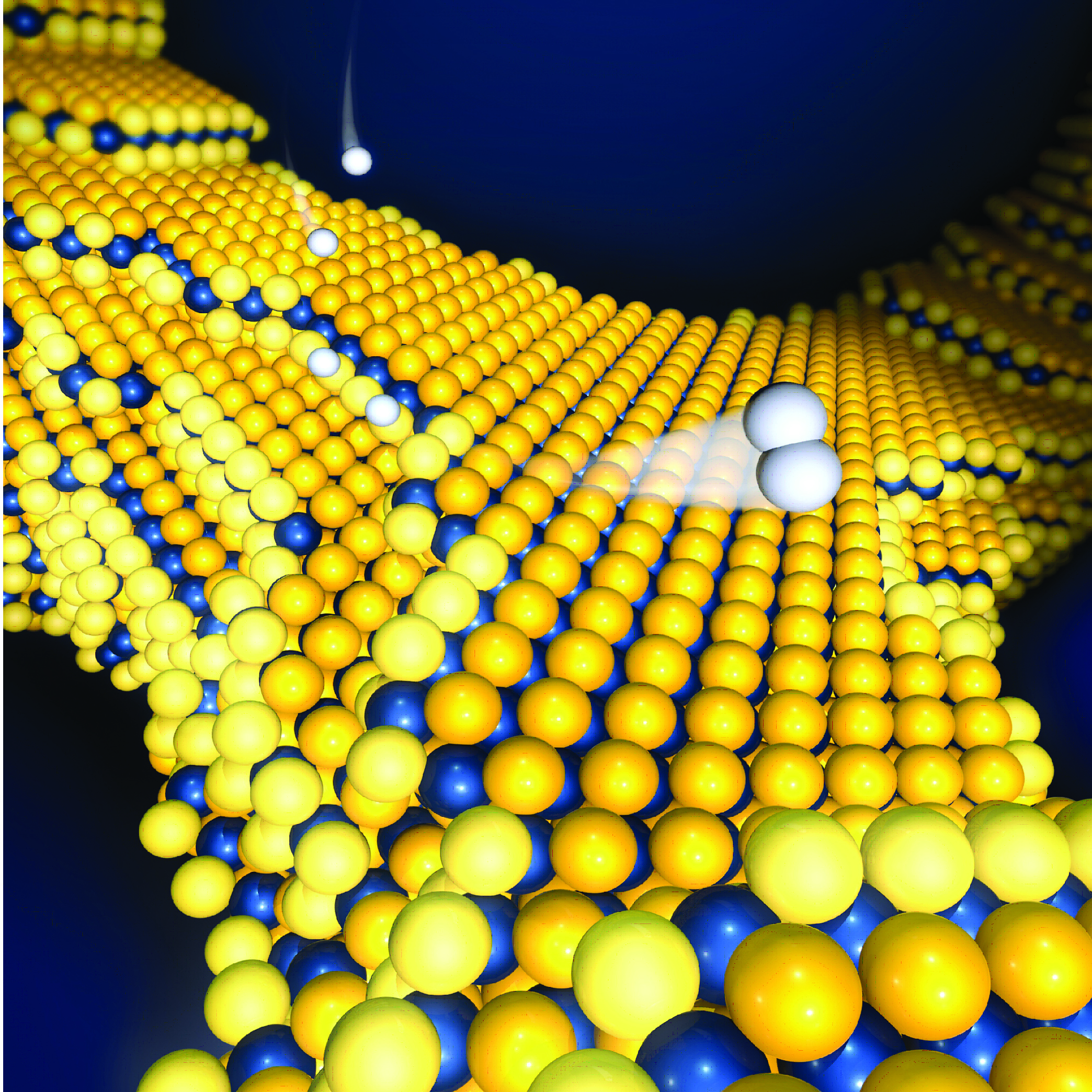
By applying a nanometer-scale casting process, scientists have successfully synthesized thin films of a molybdenum sulfide, MoS2, catalyst with unprecedented activity for the production of hydrogen from water. Electrocatalysts are materials that drive chemical reactions with the aid of electricity. Researchers at the Center on Nanostructuring for Efficient Energy Conversion, or CNEEC, demonstrated this innovative approach to synthesize a MoS structure, which contains up to four-fold more catalytically active atoms on its surface than previous thin-film MoS2 catalysts. By maximizing the number of active centers, the nanostructured MoS2 catalyst exhibits greatly enhanced activity.
Turning water to hydrogen. The use of hydrogen in fuel cells and other applications is considered the Holy Grail for a future sustainable society. Its use does not result in environmentally harmful emissions. Its production can be fully renewable if sunlight or electricity derived from wind power is employed. Hydrogen can be produced from water by the combination of electricity and a catalyst, a process called electrocatalytic evolution of hydrogen.
The action occurs at the edge. MoS2 is an inexpensive and efficient catalyst for the electrocatalytic evolution of hydrogen. However, only a minor fraction of the atoms on the surface of MoS2 is indeed capable of driving the reaction. "Those efficient catalytic sites are located at step edges on the MoS2 surface," explains Thomas Jaramillo, who led the study at Stanford University. "The majority of the surface atoms, located at flat terraces, are mere spectators."
A rough surface, with a high proportion of steps, would be therefore more efficient than a more regular, flat surface. To design superior electrocatalysts, one would ideally want to maximize the proportion of step edges on the MoS2 surface.
Getting the nano-catalysts out of the mold. The scientists at CNEEC developed a synthesis strategy that imparts a high degree of curvature to the porous MoS2 catalyst at the nanometer scale. As a frame of reference, if the walls of the pores of this material would be as thick as our apartment's walls, a virus would be larger than a person. To achieve such curvature, MoS2 was prepared by first synthesizing a silica material with a highly twisted, three-dimensional porous structure as a "mold." The precursors for MoS2 were deposited inside the pores of the silica. The silica cast was chemically removed leaving behind a porous MoS2 replica. This can be seen as the nanoscale version of taking a cake out of the mold. The highly tortuous MoS2 structure exhibits an unusually high proportion of the desired step edges on its surface.
As an essential step towards integration in electrochemical devices, the novel "nano-casted" catalyst was assembled in the form of thin films supported on a conducting material or substrate. "Discovering a route to fabricate thin films of the porous MoS2 that were electrically connected and contiguous over large areas proved to be the greatest challenge," said graduate student Zhebo Chen. "We were able to leverage knowledge that we previously gained working with metallic films to also achieve this unique nanoscale architecture with MoS2."
Jakob Kibsgaard, who participated in the project as a visiting scholar, envisages improvements: "Further research on the addition of other metal atoms to the structure is expected to enhance the activity and potentially enable our porous MoS2 to compete with the best precious metal catalysts available today."
The new nanostructuring approach opens horizons to controllably prepare thin films of MoS2 and other materials with superior properties for applications in catalytic reactions driven by temperature, electricity or sunlight for the production of green fuels.