

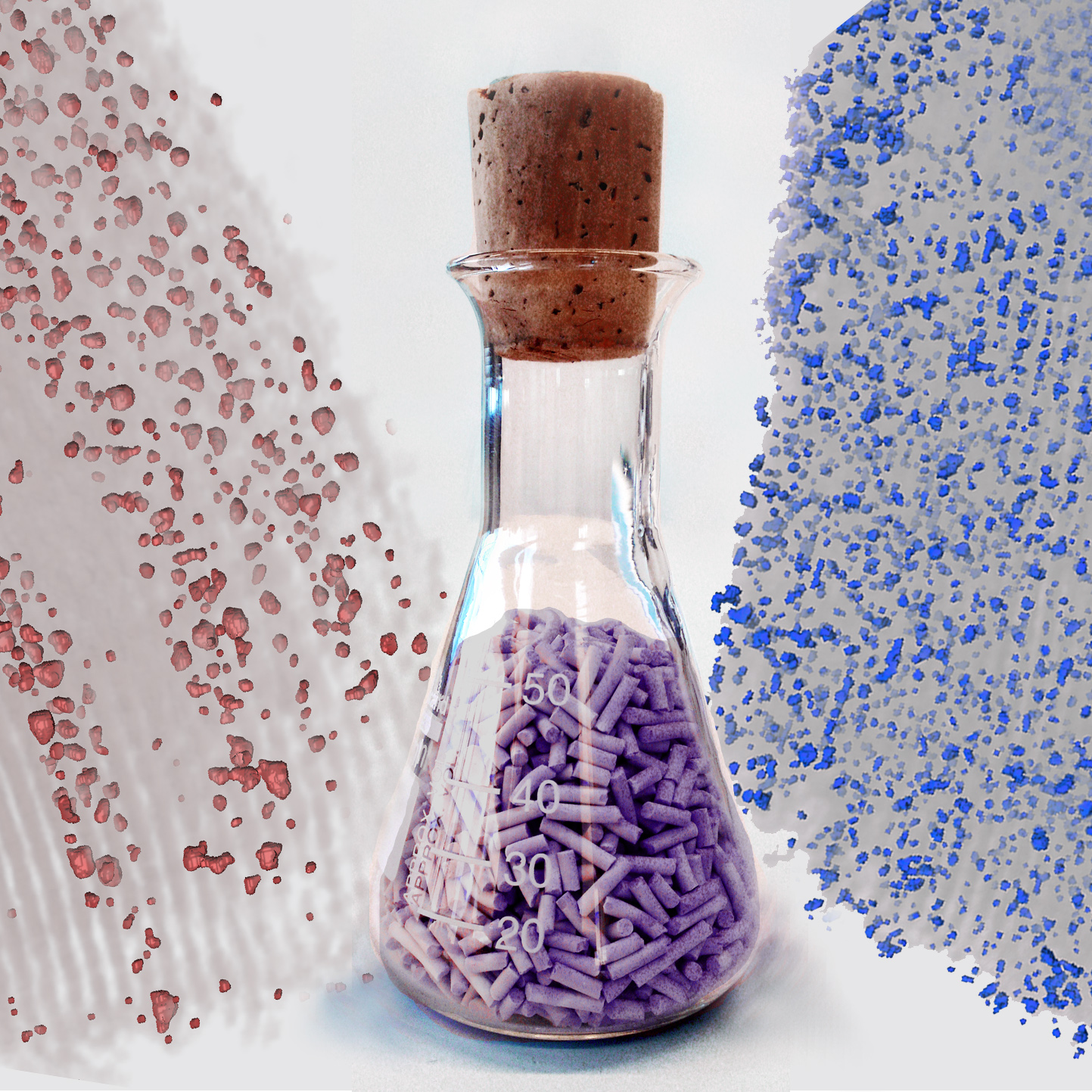
Chemical reactions can be sped up with the use of catalysts – materials that lower the overall energy barrier for a reaction. The chemical industry uses catalysts consisting of metal nanoparticles dispersed in three-dimensional porous matrices for the synthesis of transportation fuels and various chemical feedstocks. One shortcoming of these catalysts, however, is their finite lifetime due to deactivation. This can occur when the metal nanoparticles fuse into larger crystals. Researchers at the Center for Atomic-Level Catalyst Design, CALCD, are demonstrating that control over the spatial distribution of metal nanoparticles is a powerful strategy for designing catalysts with longer lifetimes.
At the heart of every catalyst, be it the enzymes in your body or the converter in your car, lies an inorganic element, often a metal. Being engineers far less impressive than our own bodies, we have historically relied on trial and error to develop catalyst technologies, some applications of which include sensors, gas storage, batteries and fuel synthesis. The new tools developed by CALCD, further discussed in a recent study published in Nature Materials, pave the way towards the rational design of longer-living catalysts and other materials for these applications. As a result, scientists believe progress in these fields can be accelerated.
Smaller is better. Generally, a higher metal surface area in catalysts translates into improved overall performance. This increased surface area is realized through smaller metal particles, and in this case, down to the nanometer scale. However, freely suspended small nanoparticles don't last too long for most purposes because they tend to move around (even within solids) and can fuse into larger, less-effective clusters. This translates to a shorter catalyst lifetime, greater frequency of replacement and, ultimately, higher costs. It is therefore advantageous to set these nanoparticles within a solid three-dimensional structure. Scientists at CALCD were the first to prepare copper nanoparticles smaller than 6 nanometers embedded into a silica honeycomb-like matrix.
Out of order comes longevity. CALCD scientists are developing novel catalyst design tools and three-dimensional imaging technologies to explore and optimize the spatial distribution of copper nanoparticles within their silica matrices. Until now, it has been difficult to control both the particle size and the inter-particle distance in catalyst frameworks. In fact, this issue hasn't received much attention because no definitive correlation has been drawn between this characteristic and catalyst performance. Specifically, no methods previously existed to simultaneously elucidate individual properties of the nanoparticles, such as their size, in addition to collective features such as their positioning relative to their metal neighbors. The researchers at CALCD take a step toward overcoming these limitations, using a three-dimensional electron microscopy technique to visualize and measure inter-particle distances between copper nanoparticles. They found that, relative to many commercial catalysts, larger inter-particle distances enabled increased catalyst lifetime when applied to the conversion of syngas to methanol. Thus, larger inter-particle spacing prevents what may be migration of nanoparticles into larger, less efficient structures.
