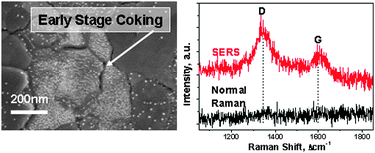
Minute amounts of an elusive chemical poison and other molecules were detected on the electrode surface of solid oxide fuel cells by a collaborative team of researchers at the HeteroFoaM Center using a technique called surface-enhanced Raman spectroscopy, or SERS. The technique provides a versatile method to study how some molecules can foul electrodes and how other molecules can boost performance, as reported in Physical Chemistry Chemical Physics.
Power Plants of the Future: Solid oxide fuel cells are electric generators powered by fossil fuels. Rather than burning the fuel and mostly generating heat like combustion engines, solid oxide fuel cells collect electrons through a chemical reaction and contain no moving parts. As a result, they are much more efficient than conventional power plants using steam or gas turbines.
The problem is that fossil fuels contain a lot of carbon, which is an elusive chemical poison to solid oxide fuel cells. Even trace amounts of carbon are enough to choke up a fuel cell’s electrodes, which contain the catalysts that jump-start the electricity-producing chemical reactions. While some modifications to the electrode chemistry have improved carbon tolerance, understanding how the electrodes work and how carbon forms on the surface are big steps towards commercializing solid oxide fuel cell power plants.
Better Signals Over Here: To probe the trace amount of chemical species that trigger catalytic activity, Xiaxi Li and his co-workers at the HeteroFoaM Center applied the SERS technique to different electrode materials. By decorating the surface with silver nanoparticles, the signal from a chemical species could be enhanced by a factor of up to ten. Using SERS allowed the researchers to detect carbon on the surface of a nickel electrode briefly exposed to propane where normal Raman detected no carbon signals, meaning SERS could be used to study the progress of carbon as it fouled the nickel electrode.
In another experiment, the SERS technique detected a very thin film of cerium oxide, which helps nickel resist carbon deposition. The thin film was undetectable with normal Raman. Li added, "[SERS] opens up many opportunities for us to really understand the mechanism of electrochemical catalysis, for example, why some catalysts enhance the fuel cell performance and what chemical species cause the electrode degradation."
Rationally Designing Materials: Applying SERS to study solid oxide fuel cell electrodes is part of a thematic focus of the HeteroFoaM Energy Frontier Research Center whose overall goal is to rationally design new materials. The SERS technique is an example of a developing in situ characterization technique. Like watching the gears turn inside a watch, peering into what is typically hidden, in situ characterization techniques can detect molecules on the electrode surface as the reaction is happening, providing clues as to how certain chemical reactions take place. Other HeteroFoaM researchers can use the information from SERS and other in situ characterization techniques to build models for the carbon poisoning reaction and predict new carbon-resistant catalysts, which HeteroFoaM experts in electrode synthesis and processing can then build, test, and optimize.
Li and other colleagues are working on making the SERS technique more durable so that experiments can be carried out under harsher but more realistic conditions. They plan to use this knowledge to design carbon-tolerant fuel cell electrodes.