Researchers at the Catalysis Center for Energy Innovation have developed a crucial step that enables conversion of inedible biomass, such as grass or corn stalks, to polyester PET, the ubiquitous plastic with triangular recycling code "#1," used in everything from clothing to soda bottles. Their work has been published in the journal ACS Catalysis.
The Assembly Line: In addition to fuels, we use petroleum in production of consumer goods ranging from nail polish remover to plastic bags. The great challenge in producing these "petrochemicals" from renewable biomass is selectivity — we want to maximize production of desired chemicals and minimize production of all others. In addition to higher yields, highly selective processes decrease costs by decreasing the need for expensive purification processes. Where fossil fuels are primarily carbon atoms, biomass-derived feedstocks contain many "oxygenated groups," consisting of oxygen atoms and the carbon atoms bonded to them. These groups are very reactive when coupled with acid catalysts, so it is difficult to design a process promoting one particular reaction over all others. While this is a potent challenge, the benefit to having so many possible reactions is the array of potential products achievable if the chemistry can be controlled.
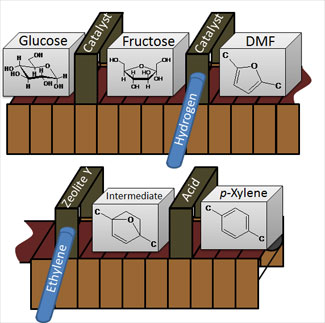
To maximize product yield, feedstocks pass through the catalytic assembly line: a series of processes each using a unique catalyst. The carefully selected catalyst cuts just the right bonds and aligns new bonds to form. Then, the intermediate product is separated and moved down to the next station of the assembly line. One such system begins with inedible biomass (including corn stalks, switchgrass, and even paper mill waste) being converted to glucose, then to fructose, and finally to dimethylfuran (DMF), a potential biofuel. However, this is no longer the end of the line.
The Newest Addition: Paul Dauenhauer led a group of CCEI researchers from the University of Massachusetts and the University of Delaware to optimize a new process extending the biomass-fed assembly line onward to para-xylene, a critical feedstock for production of polyester PET. The research team optimized a process for converting DMF and pressurized ethylene to para-xylene at high conversion and selectivity greater than 75 percent by using a zeolite catalyst.
Zeolites are acidic, porous particles composed of "cage-like" pores that are less than a nanometer in diameter, the same scale as the reacting molecules, and it is these pores that make zeolites desirable as catalysts. Simple acids like hydrochloric acid will react with oxygenated groups indiscriminately, making selective chemical transformations virtually impossible. Inside the zeolite, however, the confined space forces the molecules into specific configurations, which can encourage some reactions and prevent others. The research team tested zeolites with pores of different shapes and sizes and found Zeolite Y to excel for this particular reaction.
The "cages" that make up Zeolite Y are exactly the right size for this reaction. DMF and ethylene can fit inside a cage together, but the tight space drives them together to react. A second, faster reaction is catalyzed by the acidity of Zeolite Y, which cleaves the oxygen off the intermediate to form para-xylene and water. The team followed up their experiments with quantum chemistry calculations showing that the first reaction was the slowest or rate-limiting, thereby explaining why the cages of Zeolite Y are so important.
Next in Line: "This work is a clever demonstration of zeolite catalysis to provide a new synthetic pathway to an important chemical," says Professor Mark Davis at the California Institute of Technology, whose own research on zeolites has identified a catalyst for the glucose-to-fructose segment of the process.
As the use of biofuels grows, the corresponding need for biomass-derived non-fuel chemicals and plastics will grow as well. Full implementation of this technology could lead to renewable production of consumer plastics from domestically grown trees and grasses rather than from oil.