
The catalytic chemistry of biomass has for decades been a black box from which biofuels and chemicals emerge. Now, researchers from the Catalysis Center for Energy Innovation have developed a combined experimental and computational method that can determine the fundamental reaction steps involved in producing biofuels. This research is the first step toward designing custom catalysts for biofuel production.
Complexity of the problem: Thousands of chemical routes could be taken to convert biomass, such as switchgrass, to industrially relevant products.Determining the dominant pathway, or set of reactions that convert a starting material to product, is similar to looking at a U.S. highway map and trying to determine the best route between Boston and Los Angeles. On such a trip, road construction, refueling breaks, and other delays must be accurately predicted to determine the best route.
An analogous problem arises in catalytic conversion of biomass. Biomass molecules react faster when a metal catalyst is present. Furthermore, these molecules follow different pathways on the metal surface, and the route taken depends on reaction conditions such as the type of metal catalyst employed. Because biomass molecules have so many different atoms and bond types, the number of ways a molecule can break down or re-form on the surface is very large, implying that there are many potential routes for converting biomass.
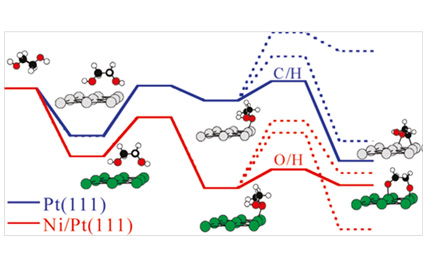
Revealing biomass pathways: The researchers created a global map for the biomass conversion reactions. They determined the likelihood of each reaction on a particular catalytic surface. These parameters were input into the global map, and the updated map was used to determine the energetically preferred conversion route for the catalyst.
Once a reaction map was constructed for a particular catalyst, the scientists re-computed reaction parameters for a different catalyst and determined how the new catalyst affects the conversion process. For the catalysts examined, the team showed that adding a small amount of nickel to a platinum catalyst drastically speeds up important reactions. By reducing the resistance for specific reactions, they showed that the overall biomass conversion rate can be substantially increased.
“This is a significant breakthrough in the reaction engineering of biomass catalysts which will allow us to understand the fundamental reactions of biomass molecules on metal catalyst surfaces,” says Wei Fan, a biomass conversion researcher on the team who works at the University of Massachusetts.