
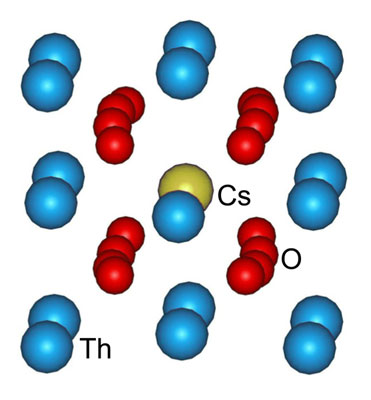
The uranium-based nuclear fuel cycle has a strong legacy in the United States — we first learned about controlling chain reactions during the Manhattan Project, and uranium has since become the prime choice for fuel in nuclear reactors. With concerns of proliferation and long-term storage ever-present, scientists in the Materials Science of Actinides Energy Frontier Research Center are looking in another direction: thorium-based fuels.
Looking past the legacy of a uranium-based fuel cycle: Solving a major concern, the thorium-based fuel cycle offers more proliferation resistance because plutonium-239, which can be used in the production of a nuclear weapon, is not created.
“Worldwide thorium reserves are much larger than uranium reserves, and the production of plutonium and other long-lived actinides is greatly reduced by the thorium fuel cycle, so there is both proliferation resistance and less concern environmentally for long-term waste disposal,” says William Weber, senior author on the recent thorium study published in the Journal of Nuclear Materials.
Nuclear fission, an important part of the nuclear fuel cycle, occurs when heavier atoms are split into lighter ones. The thorium nuclear fuel cycle results in the buildup of lighter fission products — Kr, Xe, Br, Rb, Cs and I, for example — that decrease fuel performance. By exploring how these fission products are incorporated and migrate in thorium fuel materials, through a computational study, Weber’s group hopes to allow better prediction of the structural evolution, properties, and performance of thorium fuels.
According to Weber, volatile fission products not only affect the thermal conductivity of fuel in a reactor, but they also contribute to the performance and safety of used fuel held in interim storage. Increasing the understanding of fission product behavior is valuable for both long-term safety and performance.
Calculating efficiency in experimental trials: This study contributes to the efficiency of proposed experimental trials by suggesting that rubidium is the fission product most likely to be incorporated and that xenon is the least.
“Theory provides guidance on which experiments to do, allowing us to investigate the most mobile fission product first,” says Weber.