

Changing one small protein changes the entire photosynthetic membrane and has deleterious effects on light harvesting
Peter Adams
Image

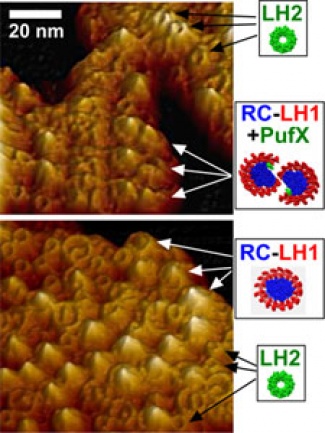
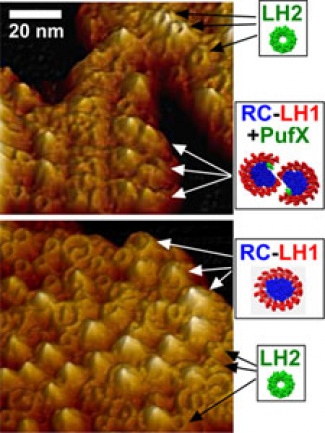
Atomic force microscopy of photosynthetic membranes from the bacterium Rhodobacter sphaeroides. Contrast represents the measured height of features. (top) Three-dimensional image of a membrane patch from the natural bacteria. RC-LH1 protein complexes (with PufX) are twinned; LH2 complexes are smaller rings. A 20-nanometer-scale bar is shown. (bottom) Three-dimensional image of a membrane patch from the bacteria without the PufX protein. Single RC-LH1 protein complexes form large rings; LH2 complexes are smaller rings.

Image

Three-dimensional images of photosynthetic membranes of Rhodobacter sphaeroides. Contrast represents the measured height of features. (Top) Membrane patch from the natural bacteria. (Bottom) Membrane patch from the bacteria without the PufX protein. Single RC-LH1 protein complexes form large rings; LH2 complexes are smaller rings.

In the quest to harness solar energy for fuel, the Photosynthetic Antenna Research Center studies the highly efficient process of photosynthesis, aiming to create next-generation energy-harvesting devices. PARC researchers showed that altering one small protein completely rearranges the hundreds of other proteins that comprise the light-harvesting network. These studies provide the first clues about the role of protein organization in trapping of solar energy.

Photosynthesis works because groups of thousands of chlorophyll molecules capture photons and funnel the energy to a reaction center, or RC, protein, where conversion to electrical energy occurs. These chlorophylls are attached to proteins, forming light-harvesting, or LH, complexes that sit side-by-side in a membrane a few nanometers thick. Understanding how these LH complexes are arranged and connected in the membrane is critical to photosynthesis.

A photosynthetic bacterium, Rhodobacter sphaeroides, was studied, because it performs similar reactions to plants, but is easier to grow and study. The researchers used an atomic force microscope to create a nanoscale map of a photosynthetic membrane. The AFM images show how bacterial photosynthetic membranes are packed with LH2 complexes that collect solar energy and transfer it to RC complexes surrounded by a dedicated complex called LH1. The very high efficiency of these nanoscale solar energy collectors lies in the size, shape and membrane organization of these complexes.

To find out what would happen if the membrane organization was altered, the team used genetics to disrupt a single, small protein named “PufX,” which is part of the RC-LH1 complex... In two sets of experiments, the protein was either truncated or completely removed. Normally, RC-LH1 complexes are twinned in the membrane, but the loss or shortening of PufX converted them to single complexes and completely reorganized the membranes with a consequent drop in solar energy conversion.

These investigations showed that with the power of genetics and high-resolution microscopy, scientists can explore large-scale disruptions to natural photosynthesis. The more we understand about photosynthesis, the closer we get to realizing its potential in cheap and efficient conversion of solar energy to fuels for us all.

More Information

Adams PG, DJ Mothersole, IW Ng, JD Olsen, and CN Hunter. 2011. “Monomeric RC–LH1 Core Complexes Retard LH2 Assembly and Intracytoplasmic Membrane Formation in PufX-Minus Mutants of Rhodobacter sphaeroides.” Biochimica et Biophysica Acta 1807(9), 1044-1055. DOI: 10.1016/j.bbabio.2011.05.019.

Ratcliffe EC, RB Tunnicliffe, IW Ng, PG Adams, P Qian, K Holden-Dye, MR Jones, MP Williamson, and CN Hunter. 2011. “Experimental Evidence that the Membrane-Spanning Helix of PufX Adopts a Bent Conformation that Facilitates Dimerisation of the Rhodobacter sphaeroides RC-LH1 Complex Through N-Terminal Interactions.” Biochimica et Biophysica Acta 1807(1), 95-107. DOI: 10.1016/j.bbabio.2010.10.003.

Acknowledgements

The laboratory of C. Neil Hunter was supported as part of the Photosynthetic Antenna Research Center, an Energy Frontier Research Center funded by the U.S. Department of Energy, Office of Basic Energy Sciences. Peter Adams was supported by a doctoral studentship from the Biotechnology and Biological Sciences Research Council (UK).

About the author(s):

Peter Adams is a postgraduate student and member of the Hunter lab at University of Sheffield, and he will soon publish his Ph.D. thesis. He is studying photosynthetic membranes using high-resolution atomic force microscopy, transmission electron microscopy and molecular biology techniques.

Newsletter Articles

Research Highlights