
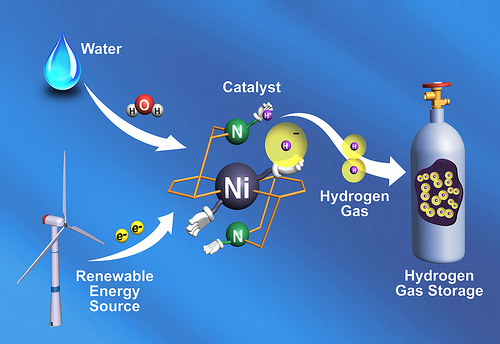
Electrocatalysts that are efficient, fast and affordable at generating chemical fuels are a critical element for a renewable energy economy. Scientists at the Center for Molecular Electrocatalysis have reported an important discovery towards this goal, a molecular nickel-based catalyst that produces hydrogen at over 100,000 times a second.
The current fossil-fuel-based energy economy has high environmental and national security costs. Moving towards renewable energy sources, such as wind and solar power, can alleviate these problems, but their intermittent nature results in an unpredictable energy supply. For this reason, renewable energy technologies must be coupled with improved methods of energy storage. Chemical fuels such as hydrogen are an ideal solution because of their high energy densities. Catalysts that are cheap, efficient and fast are necessary to make the generation and utilization of chemical fuels economical.
Hydrogen is a candidate for use as a chemical fuel and can serve as a feedstock to generate other fuels. However, the most efficient method of generating hydrogen from non-fossil fuel sources requires the use of platinum, a precious metal more expensive than gold. Nature also uses hydrogen as an energy carrier, and performs the necessary catalytic reactions efficiently and quickly with enzymes composed of abundant iron and nickel. One of these enzymes, [FeFe] hydrogenase, integrates a chemical group near the center or active site that facilitates proton movement.
The new catalyst from the Center for Molecular Electrocatalysis incorporates some of the elements that make [FeFe] hydrogenase a successful catalyst. Although not as efficient as the enzyme, it catalyzes the production of hydrogen 10 times faster, exceeding the rate of any known molecular catalyst for hydrogen production. The insights gained from this catalyst are contributing to continued research into more efficient catalysts that operate at high rates.