
Imagine your cell phone reliably powered by sunlight. To make this a reality, energy from the sunlight must be absorbed by a semiconducting material and separated into charges. Using a new research technique, scientists at the Charge Separation and Transfer Energy Frontier Research Center are developing a better understanding of organic polymer materials that behave like semiconductors.
Unlike traditional semiconductors, materials that conduct electricity, organic polymers are easy to prepare for mass production through techniques like printing on flexible surfaces. Understanding the properties that control energy transfer in these materials could go a long way in increasing the efficiency and lowering the cost of solar cells.
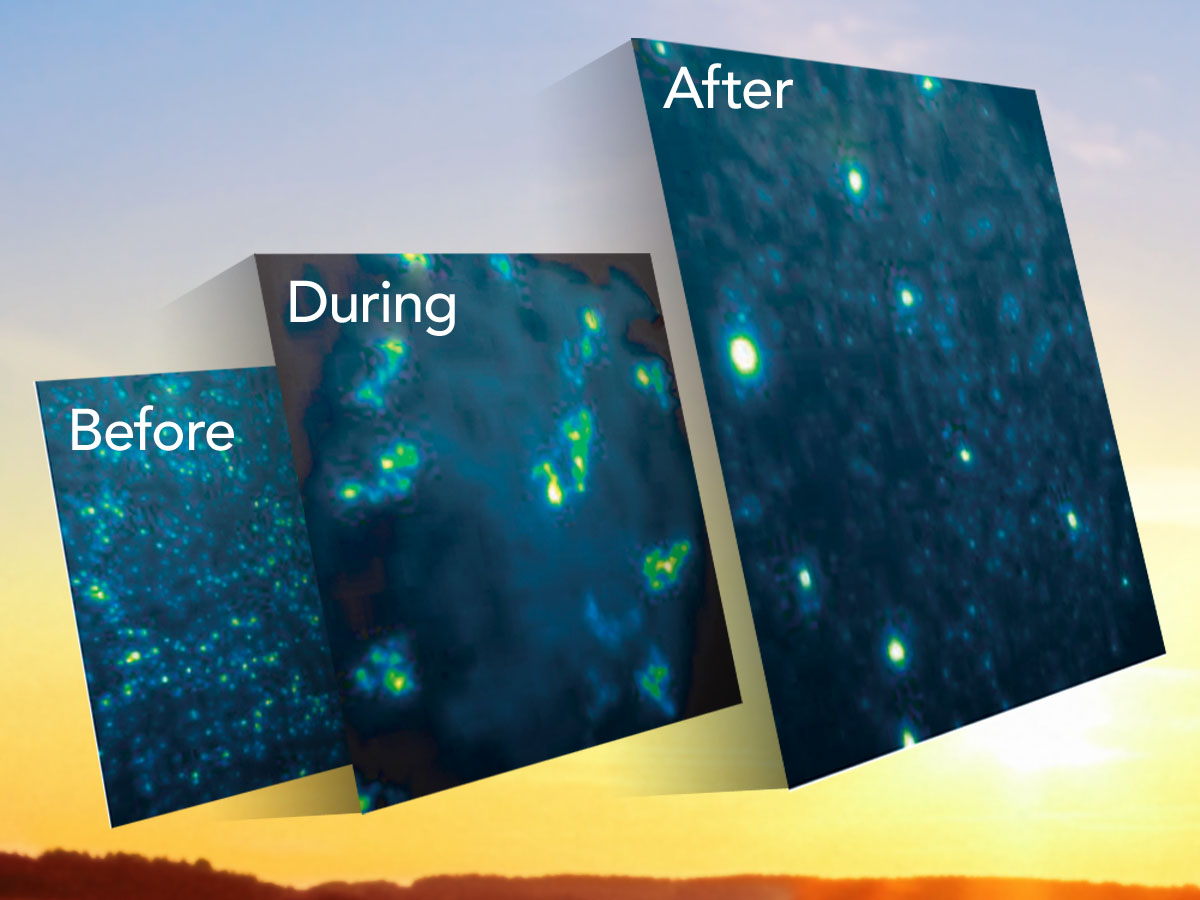
Earlier this year, CST researchers introduced solvent vapor annealing in an article in Angewandte Chemie as a new method for affecting the arrangement of single conjugated polymer chains, a type of semiconducting polymer. The CST researchers expanded this technique to create polymer chain aggregates, facilitating study into the property changes that occur as single polymer chains transition to a bulk polymer film.
“We really want to know how you go from a single chain to a film,” says David Vanden Bout, senior author on a second paper from the CST that appeared in Nature Materials. “There are a lot of differences between one individual polymer chain and many of them packed together in a film.”
One of those differences is energy transfer length—the distance that energy migrates before finding an interface between two different materials in a photovoltaic system. The charge separation that occurs at this interface is positively affected by an increase in energy transfer length. The farther energy can travel, the more likely it is to reach the interface and be separated into useful charges. This makes the energy transfer length of a material an important consideration in photovoltaic material development.
For bulk conjugated polymer films, the energy transfer length is 5 nanometers on average. In single conjugated polymer chains and aggregates, the energy transfer lengths are much longer, at 25 to 30 nanometers on average. This surprising result, that aggregates behave more like a single polymer chain than a polymer film, is leading the CST research team to question:“What is limiting the energy transfer in bulk films?” asks Vanden Bout. “Are bulk films so disordered that we don't see these effects? How do we make films that behave like our aggregates?”
These questions are important considerations as CST researchers continue to seek the answers that could someday change the way we charge our electronic devices.