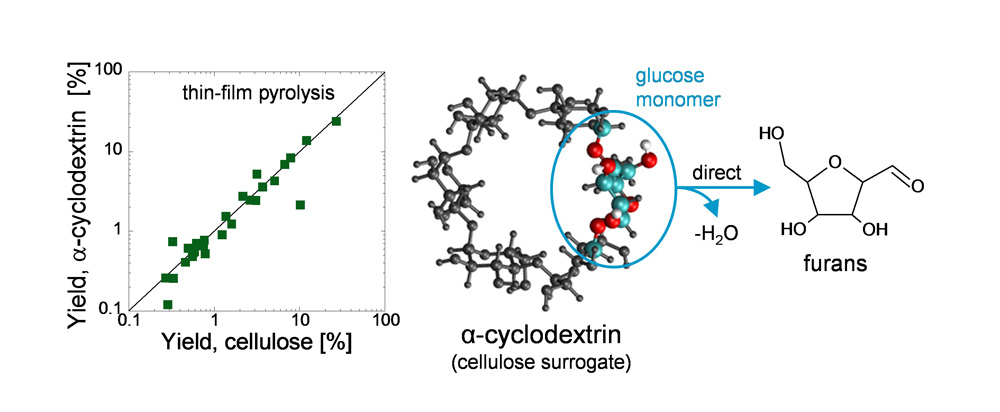
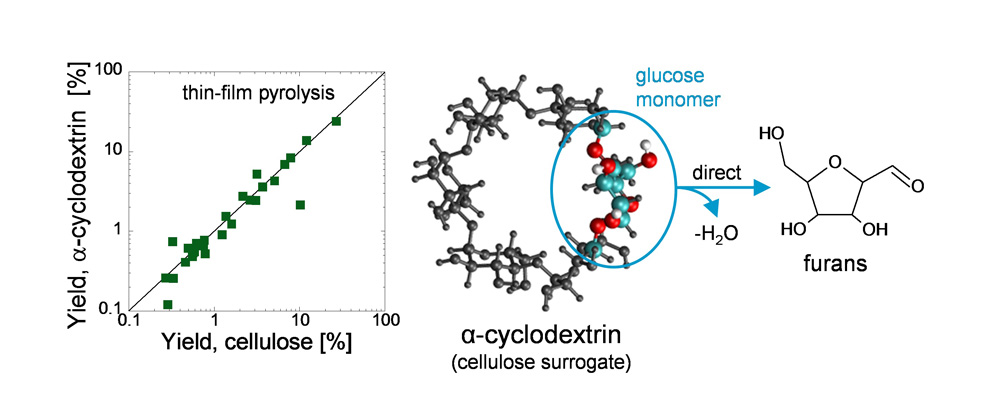
Next-generation biofuels production uses temperatures around 1000°F to convert every part of a plant into molecules that are similar to those in fuels. A series of complex processes fracture large biomolecules containing millions of atoms into much smaller molecules with higher energy density and reactivity. While this chemical deconstruction is critical to biofuels production, for decades the fundamental chemical reactions controlling this transformation have been unknown. Researchers at the Catalysis Center for Energy Innovation are seeking to remove this black box and to identify and control the chemical reactions responsible for producing biofuels from biomass in these next-generation approaches. Their work identifies, for the first time, the fundamental chemistry of high-temperature biomass conversion.
Next-generation biofuels
While conventional biofuels production relies on slow and expensive enzymatic processes to convert only the fruit of plants to fuels, next-generation approaches can convert the entire plant to fuels. This is a huge benefit because fuel can be produced from the non-food parts of the plant, leaving the fruit for food production. In these processes, biomass is converted to fuels using a relatively simple approach: plants are heated to high temperatures where they are deconstructed to form smaller, fuel-range molecules. While this conversion occurs in a single reactor, the process involves millions of solid-, liquid- and gas-phase reactions. Deciphering this complex network of reactions is challenging due to the number of chemical processes and differing timescales of these processes. Despite the difficulty, knowledge of the chemistry would facilitate the design of better processes, lower manufacturing costs and improve the overall efficiency for eventual economically viable commercialization of next-generation biofuels.
Revealing the chemistry
Researchers at the Center are able to unmask the complex chemistry of high-temperature biomass conversion by combining advanced experiments and simulations. A novel experimental technique was developed that utilizes extremely small samples, approximately the thickness of a human hair, for precise control of the deconstruction process. These advanced experiments were then coupled with powerful first-principles simulations to understand the sub-atomic details of how fuel-range compounds are formed.
Using this new approach, the researchers show that biomass deconstruction chemistry involves short-lived radical species. This implies that the pair of electrons that comprise a chemical bond part ways, rather than traveling together, during the biomass conversion process. This finding reveals the sub-atomic information of high-temperature cellulose pyrolysis for the first time and represents a critical step in understanding the underlying mechanisms of conversion of raw biomass to fuels and chemicals.
“This work yields fundamental knowledge into the underlying kinetics of biomass processing through the combination of insightful experiments and ab initio simulation,” says Michail Stamatakis, a postdoctoral fellow at the University of Delaware.
Significance for biofuels
This approach combines novel experiments with rigorous models to show how fuels form from biomass in high-temperature conversion processes and enables advanced optimization techniques to be utilized to design improved biofuels production facilities.
“This work paves the road to designing novel processes for the economical and sustainable production of chemicals and fuels from biomass,” says Stamatakis.
Such improvements are important for a large-scale, noncontroversial implementation of biofuels, one of the fastest growing fields in the renewable energy sector.