
Viruses are typically associated with death and disease; so how are they advantageous for use in battery electrode materials?
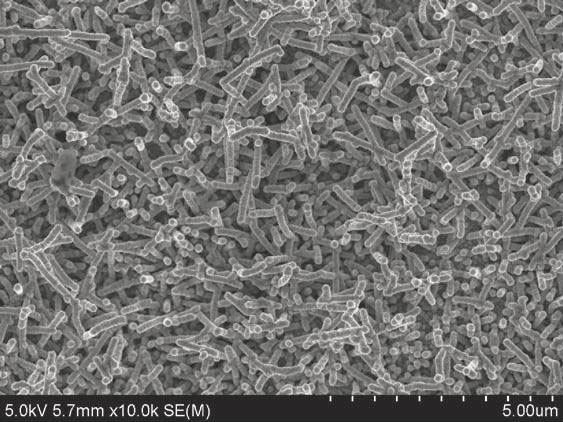
Researchers at the Nanostructures for Electrical Energy Storage, an Energy Frontier Research Center, were able to directly fabricate virus-based nickel current collectors. In this study, nanoporous silicon was deposited onto virus-based nickel current collectors for use as lithium rechargeable battery electrodes. These types of electrodes are considered anodes. In a battery, the anode provides electric current upon discharge.
James Culver, a co-author, stated the “tobacco mosaic virus is a ubiquitous plant virus that does not infect humans or animals… The virus coat protein that serves as a building block for the rod-shaped virus particle was genetically altered to both enhance its ability to attract metal ions as well as vertically orient the rod-shaped particle onto a surface.”
The study reported improved rate performance, cycling and rate stability of the silicon-based anode; exhibiting higher capacity than existing graphitic anode technologies.
Silicon is a promising anode material for next-generation high-capacity lithium rechargeable batteries because of its high theoretical capacity (3572 mAh g-1). Graphite anode materials operate at capacities around 372 mAh g-1.
However, silicon anode materials’ commercialization is hindered by their large volume change during charge and discharge; the large volume change leads to silicon particle pulverization and subsequent electrode failure. Pulverization of silicon particles can be alleviated by reducing the particle size and introducing nanopores into silicon.
Under the guidance of Chunsheng Wang, corresponding author, the team also pioneered the use of electrodeposition to directly coat nanoporous silicon thin-films onto virus-based nickel current collectors, demonstrating this technique as a viable, cost-effective approach towards development of anode materials.
Reza Ghodssi, a co-author, remarked that “the self-assembly properties of the TMV, and our ability to selectively pattern these biomaterials using fabrication techniques, make them highly suitable for microbatteries in micro and nano systems.”
At NEES, developments in creating predictable, regular arrays of nanostructures, optimizing their materials and understanding their charge transfer behavior at the nanoscale are crucial details to their mission as an Energy Frontier Research Center.