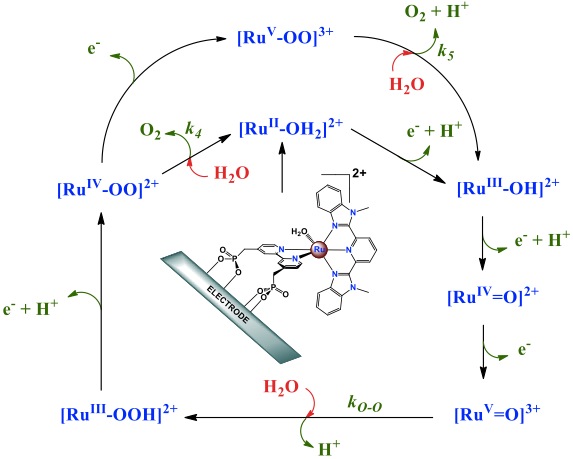
A 12-fold increase in the rate of water splitting was achieved using a transparent nanocrystalline electrode made of indium oxide doped with tin (ITO), instead of a conventional planar electrode. Catalysis was sustained for at least 8 hours, equivalent to ~800 turnovers, at a rate of ~0.027 s-1 and an impressive 95% oxygen yield. This work, conducted by theSolar Fuels and Next Generation Photovoltaics Energy Frontier Research Center in conjunction with the Center for Catalytic Hydrocarbon Functionalization, is perhaps the first demonstration of using a transparent electrode to monitor spectral changes of the catalyst during water splitting, yielding a comprehensive picture of each step in the reaction.
Challenges in electrocatalysis: Using molecular catalysts to split water, technically referred to as water oxidation, into hydrogen and oxygen gas is key for solar fuel applications because it provides a method for storing and generating fuel. Until recently, water oxidation electrocatalysis was largely accomplished using multi-site catalysts that were inefficient and difficult to synthesize. Planar electrodes with low surface areas also prevented spectral monitoring of intermediates so that mechanistic details remained elusive. This left the door open for two major advancements that have recently been demonstrated by Tom Meyer’s group at the Center.
1) A breakthrough in water oxidation catalysis: Facile synthesis of an efficient molecular catalyst that drives water oxidation using a single-site mechanism was created. The ruthenium-based complex is technically referred to as Ru(Mebimpy)-(4,4’-((HO)2OPCH2)2bpy)(OH2)]2+. Ru-OH22+ Mebimpy is 2,6-bis(1-methylbenzimidazol-2-yl)pyridine; bpy is 2,2’-bipyridine. The complex can be bound to conducting oxide surfaces such as ITO, which are commonly used as electrodes.
2) Watching water splitting through a transparent, nanocrystalline electrode: The preparation of high surface area, nanocrystalline ITO films, which are both conductive and transparent, were used to spectrally monitor water splitting in real time. The result is meticulous characterization of the catalytic mechanism and key intermediates.
In solar fuel applications, an efficient and robust method for splitting water is a promising way to store and generate fuel in a sustainable manner, and represents one of the major challenges facing the EFRCs. The work described in this article overcomes many of the barriers that hampered this process and is a pioneering effort towards the realization of efficient catalytic water oxidation.