
The performance of organic or carbon-based solar cells can be greatly improved by using a second solvent, or additive, during the processing of the organic materials, according to scientists at the University of California, Santa Barbara working in the Center for Energy Efficient Materials. The team gained insight into what that additive does using highly specialized imaging techniques. Their research was published in Advanced Energy Materials.
Organic solar cells can be prepared by dissolving organic light-absorbing materials that actually convert light into energy in an organic solvent and depositing that solution onto an electrode (later to be sandwiched by another). The resulting films are thinner than paper, flexible, lightweight and inexpensive compared to their inorganic counterparts. In the future, one can imagine having printed OSCs in any shape for any use; however, the full potential of OSCs has yet to be unlocked, and research is ongoing.
One factor that dictates how well an OSC device will perform is how the different organic components organize when they become a solid film. This is especially challenging because most OSCs have more than one organic material, and ideally the materials should be in contact but not mixed. Scientists spend months optimizing the preparation of a device, tuning variables like the concentration of organic materials, different types of filters for solutions or heating films to allow materials to crystallize. What scientists at Center for Energy Efficient Materials have done is add a tool to the metaphorical toolbox for fabricating OSCs.
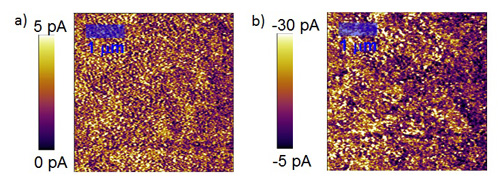
In a film deposited without an additive, one often sees large globs of one type of material, or conversely, that everything has mixed completely. But mix two solvents with different properties and two organic materials and something interesting happens – in the deposited film, organic materials tend to form their own discrete phases with good contact. Basically, with good contact comes better conduction, and using additives increased the current produced by devices prepared at the Center for Energy Efficient Materials, and in turn the efficiency, more than three-fold.