
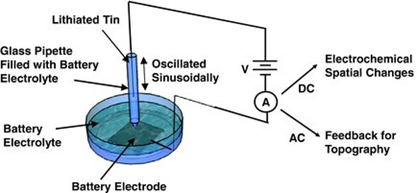
The full answer to that question may be a step closer, based on new developments in a technique known as scanning ion conductance microscopy, or SICM, by researchers at the Center for Electrical Energy Storage. Albert Lipson, a graduate student with the Center at Northwestern University, has adapted a technique used previously in the biological sciences for characterizing cellular structures to improve our understanding of how and why batteries fail.
Each electrochemical cell of a lithium-ion battery is basically a sandwich consisting of two electrodes: the anode, typically graphite, and the cathode, typically a lithium-metal-oxide, such as LiCoO2. The electrodes are separated by a lithium-ion-conducting electrolyte. When the cell is charged, lithium is extracted from the cathode and transported through the electrolyte to the anode. The reverse process occurs during discharge: lithium ions move from the anode to the cathode. While the lithium ions move through the electrolyte, electrons are transported through an external circuit to run your cell phone or the motor of an electric car. If any of these processes are seriously interrupted, the battery fails.
With the SICM technique, an extremely fine-tipped pipette, about 100 nanometers in cross section, is used to scan the electrode surface in a liquid electrolyte bath. As the pipette moves across the surface, it measures the flow of ions through the tip. Based on the measured flow, only a few picoamperes in magnitude, the reactivity of the electrode can be mapped. Simultaneously, local changes in height can be measured and when coupled with the reactivity map, these changes can give an in-depth understanding of how the battery electrodes operate during cycling.
Because SICM can monitor chemical activity and local topology, it is well-suited for studying failure mechanisms in lithium-ion batteries, particularly at electrode surfaces where damaging effects can occur. In a recent paper by Lipson and his colleagues, they report that the SICM technique can measure extremely small currents at a spatial resolution down to hundreds of nanometers. For comparison, viruses are measured on the same scale.
By investigating chemical reactions at the nanoscale, the researchers are improving their understanding of how and where irreversible side reactions, cracking and other degradation mechanisms occur. Although nascent, the technique shows promise for elucidating how and why batteries operate the way they do.