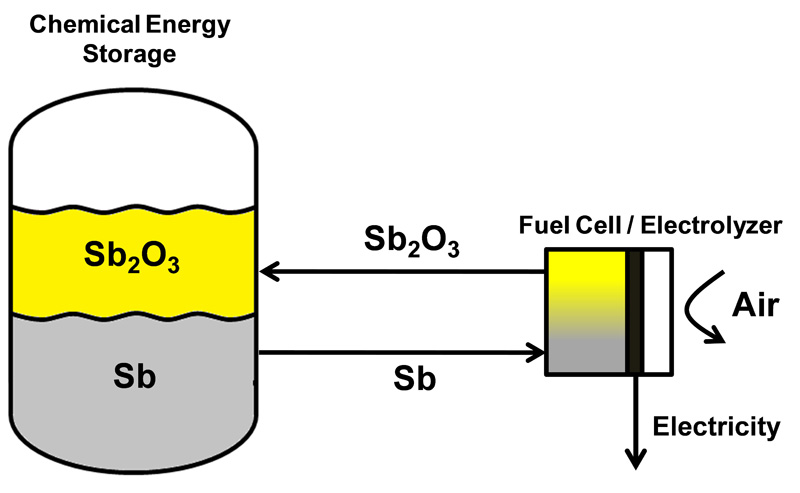
Unlike liquid fuels or chemicals, excess electricity cannot be simply stored in a tank and pumped out when it is needed later. However, researchers led by Ray Gorte of the Catalysis Center for Energy Innovation have come one step closer to that idealization by developing a new way to bottle electrical current using molten metal in a solid oxide fuel cell. Their work has been published in a recent issue of the Journal of the Electrochemical Society.
The Challenge
Demand for electricity fluctuates throughout the day as the needs of consumers change from using computers at work to appliances and entertainment at home. Many renewable sources of electricity, such as wind and solar, complicate the problem further with a varying supply of power. On the surface, the solution is simple: storage.
Storing electricity is nontrivial, however. Traditional batteries do not scale well to the high capacities required at the grid level. Fuel cells are more effective at these large scales because excess fuel can be cheaply stored for use in a limited array of fuel cells. Many fuel cells use hydrogen from water electrolysis; however, hydrogen storage is not trivial either due to the high costs and dangers associated with pressurization.There is a need for a fuel cell that can store a great deal of electricity, but is safe and compact enough to be easily integrated into the existing power grid.
Promising Solutions
Catalysis Center for Energy Innovation researchers think they may have found an answer in molten metal fuel cells. These high-temperature devices act like batteries by storing energy in the chemical state of the molten metal, which in this case is antimony. Electrical current applied to the cell in times of excess supply turns antimony oxide into antimony metal, which can be stored outside the cell. When demand rises, the cell works in reverse by turning antimony into antimony oxide, which releases the stored energy to consumers on the grid.
Previous approaches to molten metal fuel cells have focused on tin, but prohibitively low current densities were observed in these systems due to the formation of solid tin oxide, which prevents ion transfer. The use of antimony is critical to the success of the device due as antimony and antimony oxide have similar melting temperatures (903 and 929 K, respectively), an uncommon property for metals that enables the electrolyte to remain molten throughout the cycle of electricity storage and release. Additionally, previous work from Gorte and the CCEI revealed that antimony oxide can be reduced to antimony metal using lignocellulosic waste materials such as sugar char and rice starch at moderate temperatures (~900 K). In this new application however, the authors show that biomass is not required – any electrical power source will do, thereby expanding the application of antimony-based cells.
Speaking on the molten metal fuel cell project as a whole, Gorte says “This work grew out of my interest in understanding why the electrode performance reported for direct-carbon fuel cells based on molten tin was so poor. That work led to the discovery that the performance of these cells was limited by the formation of oxide films on the electrolyte, which in turn led us to look for systems where both the metal and the oxide were molten at the operating temperature. When we discovered how well antimony worked in the fuel cell application, the extension to energy storage was natural.”
New Potential
The researchers put their device through a bevy of tests to demonstrate its power storage capabilities. Their results show the device is able to run 700°C (relatively cool for this type of device) with low resistance and an energy density two orders of magnitude greater than similar technology, such as the vanadium redox battery.
"This device represents a significant step forward in low-footprint management of the power grid. High-efficiency fuel cells such as this will provide invaluable support to an expanding portfolio of renewable energy,” said Feng Jiao, an Assistant Professor of Chemical and Biomolecular Engineering at the University of Delaware studying advanced materials for energy storage.