
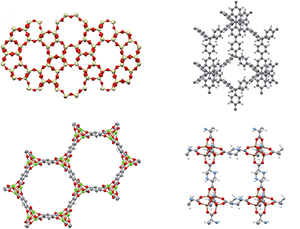
When searching for the optimum material to minimize carbon dioxide emissions from fossil fuel power plants, scientists must not only consider how well the material can selectively trap carbon dioxide, but also how much energy it will take to regenerate the material for repeated use. In a study in Energy & Environmental Science, researchers demonstrate how a new computational method, featuring a metric called parasitic energy, could be used to predict which materials are the most energy-efficient for carbon dioxide capture in fossil fuel power plants. This method could also provide a means to rapidly screen millions of materials, saving time as well as energy.
Earth is officially getting hotter: recently, NASA and the National Oceanic and Atmospheric Administration have declared 2014 as the warmest year on record since 1880. With increasing carbon dioxide emissions from the burning of fossil fuels, such as coal, oil, and natural gas, the average global temperature is projected to steadily rise.
Carbon capture and sequestration—the process of capturing carbon dioxide from the exhaust stream of fossil fuel power plants and storing it long term—has emerged as a promising technology to reduce carbon dioxide emissions into the atmosphere. An example of the process is described in the following steps:
- Carbon capture – carbon dioxide is separated from the exhaust stream of power plants, known as flue gas, before it is released into the air. After fossil fuel combustion, flue gas flows through a porous material that is designed to selectively capture carbon dioxide. Afterward, heat is applied to release carbon dioxide and regenerate the material.
- Compression – carbon dioxide gas is compressed to a supercritical fluid for transport. A supercritical fluid exhibits properties between those of the gas and liquid phases.
- Sequestration – carbon dioxide is injected into underground geologic formations for long-term storage.
Because of the extra energy needed to separate, compress, and transport carbon dioxide, applying carbon capture and sequestration to existing coal and natural gas power plants can be expensive. The team at the Center for Gas Separations Relevant to Clean Energy Technologies (CGS) has taken an approach towards reducing these costs by developing and identifying materials that will minimize the energy used during carbon capture.
The CGS team reported a useful technique to consistently evaluate various classes of porous materials, including zeolites, porous polymer networks, and metal-organic frameworks, for carbon capture. Metrics such as carbon dioxide uptake, carbon dioxide selectivity, and regeneration capability, have traditionally been used to evaluate the performance of these materials for carbon capture. However, the aforementioned metrics can only evaluate a single property of the material at a time. The CGS team thus used a more comprehensive metric that accounts for multiple properties and the optimum operating conditions of each material: parasitic energy.
Parasitic energy is a measure of the amount of electricity lost when a carbon capture and sequestration process is added to a power plant. In other words, it encompasses the additional energy requirements associated with carbon capture and sequestration.
"We asked people who design power plants to suggest the best metric we can use to evaluate materials for carbon capture at an early stage of research," said Berend Smit, who led the study. "The answer we received is 'if it is too early to calculate the cost of the entire process, use parasitic energy.' It is an abstract metric, and it works because it combines all the aspects we want in one number."
Therefore, the best materials for carbon capture are those that minimize the parasitic energy.
Using experimental data and computational models based on thermodynamics, the team calculated the parasitic energies of more than 60 porous materials. The results revealed that the carbon dioxide concentration influences which materials yield the lowest parasitic energies in coal- and natural gas-fired power plants. For example, the metal-organic framework Mg-MOF-74 was identified as the most promising carbon capture material for coal plants, where flue gas contains approximately 14 percent carbon dioxide. Meanwhile, an amine-functionalized porous polymer network, PPN-6-CH2-TETA, was optimal for carbon capture in natural gas plants, which have lower carbon dioxide concentrations (4 percent).
These results can be used to predict the energy spent removing carbon dioxide before flue gas exits the power plant, but how about after it is released into the atmosphere? For comparison, the team modeled the carbon capture directly from air, which has an even lower carbon dioxide concentration (400 parts per million). Based on the team's calculations, this method requires almost twice the amount of energy needed to capture carbon from the flue gas of coal-fired power plants. Overall, removing carbon dioxide directly from air was predicted to be the most energetically costly method to reduce carbon dioxide emissions into the atmosphere.
The team at CGS demonstrated that the center has been able to synthesize the best material to capture carbon for a model flue gas. However, this model flue gas only contains nitrogen and carbon dioxide and does not include, for example, water. In reality, flue gas contains approximately 10 percent water, which also binds more strongly than carbon dioxide to some of the porous materials. The team is working on including water in their calculations, as well as other factors such as diffusion properties of materials and the separation of methane and other hydrocarbon molecules.
"I am very happy with our results so far. We have shown that our center can tailor-make a material that is optimal for carbon dioxide/nitrogen separations, but I must point out that this is only the first step towards solving the carbon capture problem," said Smit.