
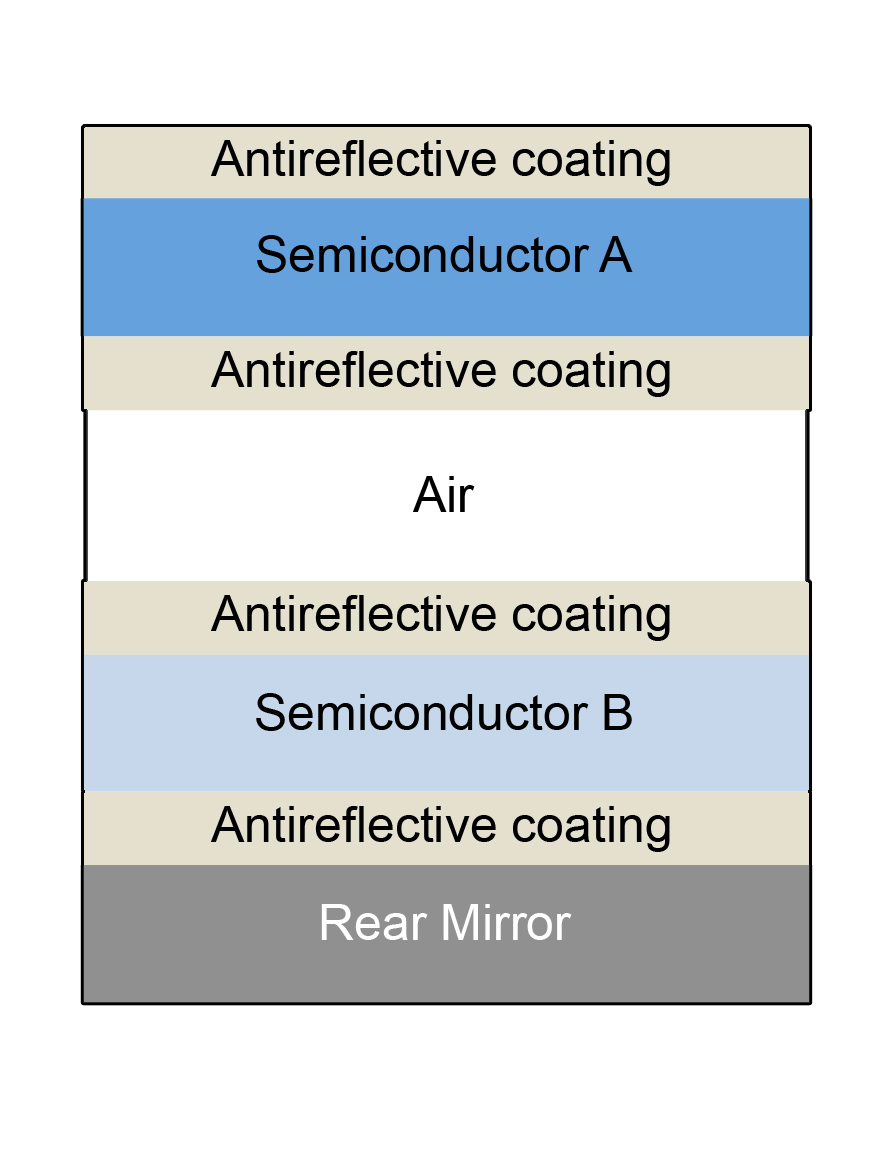
In solar cells, the materials of which they are made are often exclusively pursued for maximum efficiencies. However, even the efficiencies of many top-of-the-line materials still fall short of the theoretical maximum. To make up for the shortcomings of single absorbers, multiple materials can be stacked to capture a larger spectrum of light. These multibandgap cells, however, also fall well below the maximum possible efficiency values. Recent work conducted at the Light-Material Interactions in Energy Conversion (LMI) show that perhaps not all of the blame is on the materials, but rather on how the cells are put together.
Stacking pure materials together either directly or by use of an adhesive can change the electronic properties of each material. Counterintuitively, the trick is stacking the materials in a way that allows the material to emit light more efficiently.
When light of the right wavelength hits a photovoltaic material, it creates a brief separation of charges in the materials. These charges can be further separated, thus generating current. The charges can also recombine, which sometimes causes the emission of light (luminescence). If recombination doesn’t lead to luminescence, the photon’s energy is lost through heat or other means, resulting in poor performance of the cell. If light is emitted and reabsorbed, the loss process could repeat, further reducing the amount of useful energy that can be extracted from the incident solar radiation. However, if the geometries of the light-material interactions are fine tuned, emitted light can be preferentially directed out of the material, thus minimizing parasitic absorption and subsequent energy loss.
What the team from LMI found is that a thin, air-filled space between the materials combined with the antireflective coatings works as an intermediate selective reflector. The antireflective coating is vital to the success of the devices as they allow nearly all the exposed and emitted light to flow into and out of the device. The air gap reflects out the internal luminescence in the top layer while simultaneously allowing transmission of incident light into the bottom layer. The effect rises from the dramatic change in the way light travels through the material versus air. A rear mirror then reflects out the internal luminescence of the second layer allowing better absorption and power generation of both layers.
This work showed an observed maximum efficiency of approximately 26 percent versus the 33.5 percent maximum possible efficiency. However, by optimizing the emission of the luminescence by placing the material on a mirror and texturing the surface, this efficiency was raised to approximately 29 percent. It is a tall order to expect any system to reach a theoretical limit, yet there are gains to be made in an approximately 10 percent discrepancy between the observed versus maximum possible efficiency.
Vidya Ganapati, lead author on the paper, says, “The ideas in this paper could lead to record-breaking multibandgap solar cell efficiencies.”
Although still a simulation, the work suggests that by using existing materials and manufacturing methods, it is possible to dramatically improve the efficiency of multibandgap solar cells. The scientists are currently making a proof-of-concept device to test it experimentally.