Continued demand for energy, along with the desired withdrawal from fossil fuels, has yielded impressive technologies for alternative energy generation. However, temporal and geographic variability in wind and sunlight present a fundamental barrier to their adoption. One solution is storing electrical energy in chemical bonds. To make these bonds and to get the electrical energy back out again, catalysts to carry out these transformations are needed.
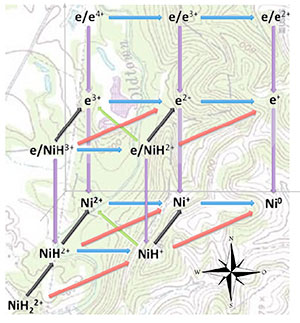
While catalysts that can do these reactions exist, they aren't perfect. For instance, one catalyst may be able to break bonds, but it can't release the energy in a useful way. To avoid such problems, Shentan Chen and his colleagues at the Center for Molecular Electrocatalysis (CME) have reported a computation-based method to predict the problems these catalysts may face. In particular, scientists want to avoid high- or low-energy intermediates in these reactions, as these troubling molecules can slow or stop the overall storage and recovery processes.The approach is similar to avoiding hills when running long distance, where the run is easier if one avoids going up and down hills wasting energy.
Other CME researchers have previously synthesized an array of these catalysts to successfully interconvert hydrogen gas to protons and electrons to generate electricity. However, synthesizing and then testing these compounds is difficult and time consuming. By using the lessons learned from these previous experiments, the CME used simply determined parameters and their new computation-based method to calculate free energy maps. These maps are readily constructed and allow the accurate prediction of potential problems in catalyst candidates. In many cases, the models provide insight for potential avenues to avoid these pitfalls.
In addition to predictability under the normal conditions used for these reactions, the model allows for predictions in different environments, which is important for making useful devices.
While the scientists note that this method does not account for all potential problems, it does identify intermediates that should be avoided. "It illustrates how powerful computing methods, integrated closely with experimental studies, lead to predictions of optimized catalysts," said Morris Bullock, CME director.
While this method was built specifically for the hydrogen-specific catalytic system, the researchers note that the strategy is amenable to almost any catalytic system. This work continues to be implemented in new catalyst design in the CME. The catalyst team has begun work on a complementary model to fill in some of the other potential bottlenecks to complete the energy landscape.