Hydrogen gas has the potential to be a limitless source of clean energy, if simple and efficient methods of production and utilization can be developed. Mother Nature has already answered this problem through one of the most important and clean processes known: photosynthesis. In that, energy from the sun is used to transform water into electrons, oxygen, and protons, the latter being the precursors of hydrogen. For this reason, reproducing the natural process in the lab is becoming increasingly important, and groups led by Ana Moore, Thomas Moore, and Devens Gust at the Center for Bio-Inspired Solar Fuel Production (BISfuel), together with researchers at Argonne National Laboratory, have developed an efficient artificial leaf that can perform the same photosynthetic mechanism as plants, algae, and microorganisms do.
To design the leaf, the team had to look into the details of the natural process, which consists of electron and proton transfers inside the catalytic unit responsible for the water transformation. In particular, a redox-active amino acid acts as the main character in this complex scenario. Indeed, this amino acid exchanges electrons with the chlorophyll and protons with a close-by molecular partner, resulting in a very efficient mechanism called proton-coupled electron transfer.
Although many efforts have been made to study this process in photosystem II (PSII), developing an artificial system able to mimic the natural enzyme is not easy. "The most challenging step was to design a structure that matches the structural requirement of the redox relay used by photosynthesis during the water-oxidizing process," said Ana Moore. "We were able to do it using the tools of organic chemistry, based on thermodynamic considerations."
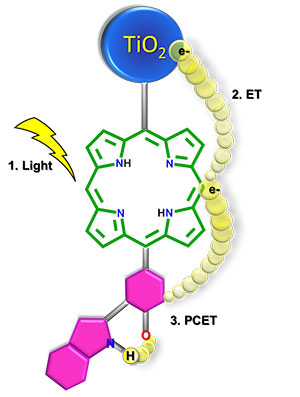
The group synthesized an organic/inorganic hybrid system composed of a nanoparticle, a porphyrin to mimic the chlorophyll, and two aromatic groups that work as the redox-active partners of PSII. The first electron transfer occurs between the photo-excited porphyrin and the nanoparticle, and the second one from the aromatic moiety to the porphyrin. Experiments and calculations show that the second electron transfer occurs with the proton moving from one aromatic group to its partner, thus mimicking the process that occurs in nature. Further experiments support the presence of a neutral radical, which is thermodynamically poised to oxidize water.
Thanks to this study, it is clearer how the natural system works, and which are the essential features to reproduce in an artificial leaf to sustainably harness the solar energy needed to provide the food, fuel, and fiber that society is increasingly demanding.
The results achieved by Moore and her colleagues reflect the research in the BISfuel Center. "An overall goal of the BISfuel Center is using the basic science of photosynthesis to design and construct a tandem photoelectrochemical cell that uses sunlight to oxidize water and generate a fuel such as hydrogen," said Gust, director of BISfuel. "Such a system needs many parts, including photochemical charge separation units, catalysts, and functional nanostructured frameworks to organize components. The work described in our Nature Chemistry paper represents an important step forward in our understanding of the processes necessary to move electrons efficiently between molecular and nanoscale components of the system. It illustrates how we can take principles from the natural apparatus and apply them in completely synthetic systems."