
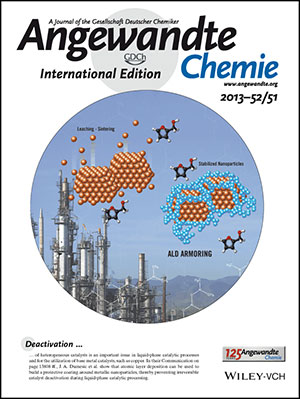
Covering the active surface of a catalyst with a non-active material seems like a crazy idea. It flies in the face of the conventional wisdom that good catalysts have as much of the active surface available as possible. However, James Dumesic and colleagues at the Institute for Atom-efficient Chemical Transformations (IACT) have discovered that such an approach leads to impressive improvements in catalyst stability while maintaining selectivity to the desired products.
The high-temperature, high-pressure liquid water conditions used to turn biomass into useful fuels and chemicals create a harsh environment for catalysts. Under these conditions, earth-abundant base metal catalysts have a tendency toward leaching and particle growth. This leads to irreversible catalyst deactivation that is costly and creates solid waste requiring disposal or reprocessing. The IACT researchers have found that an overcoating of relatively inert aluminum oxide on top of catalytic copper nanoparticles can prevent such deactivation and increase the stability of the catalysts.
This breakthrough allows inexpensive metals such as copper to be used in place of their expensive cousins, such as platinum, which are naturally more stable under the demanding reaction conditions. In turn, this may increase the viability of fuel and chemical production from renewable resources.
The overcoating method utilizes atomic layer deposition, a process that arranges films of atoms on the catalyst in a layer-by-layer manner. Initially, the whole catalytic surface is covered, but the IACT team discovered that when they heated the catalyst, tiny pores were created in the overcoat. These pores allowed the reactants to access the active copper sites where catalysis occurs, while the copper atoms susceptible to deactivation, typically located at corners and edges of the particles, were still covered and therefore stabilized. Importantly, the selectivity to the desired product of the reaction was unaffected.
Previously, IACT researchers used a similar method for stabilizing precious metal catalysts. From that study they found that the overcoat preferentially covered the corners and edges of the nanoparticles, which are the areas most likely to cause deactivation. IACT director and co-author Chris Marshall notes, “This program was started by IACT about two years ago and has blossomed into a major thrust area. We believe that we can improve catalyst stability and selectivity for a wide variety of catalytic processes by careful choice of the overcoat type, thickness, and pre-treatment.”
Efforts are now focused on understanding the precise nature of the porosity and investigation of other systems where the approach could be beneficial. “One of the first directions that we would like to explore is to change the acid-base properties of the stabilizing overcoat layer,” says Dumesic.
“It should be possible to design a bifunctional catalytic material that couples a metal-catalyzed reaction on the copper surface with an acid-catalyzed reaction within an acidic overcoat layer,” says Brandon O’Neill, the first author of the paper.