
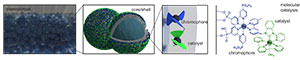
A working "artificial leaf" for solar water splitting has been constructed, based for the first time on a dye-sensitized photoelectrosynthesis cell. The cell converts about 4% of the photons into electrons, which is four times the efficiency of plant photosynthesis. The energy from about 85% of these electrons can be stored as hydrogen. Developed at the Center for Solar Fuels with collaborators from the Center for Catalytic Hydrocarbon Functionalization and North Carolina State University, the cell uses a light-absorbing (a.k.a. chromophore) and catalytic molecule bound into a molecular assembly that is tethered to a semiconducting oxide (TiO2). Light stimulates the assembly, providing the energy needed to split water (2H2O --> O2 + 4H+ + 4e-) at the electrode's surface. Until now, the electrons usually recombined with the assembly in a process called back electron transfer (BET) rather than being converted to fuel, killing cell efficiency.
The core/shell advantage. The key to overcoming BET was to construct a "core/shell" structure made up of a thin (~3.6-nanometer) TiO2 layer, constructed one atomic layer at a time over conductive tin-doped indium oxide cores (nanoITO). Compared to previous films that were micrometers thick, the electron transit time through the shell to reach the conducting nanoparticle core was significantly reduced, solving the BET problem.
Sticking it out. The ultra-thin film was also used to stabilize a molecular catalyst on the surface of nanoITO. Before this discovery, surface-bound catalysts were only stable in acidic solutions (<pH 4) where the rate of water splitting is very low. Use of atomic layer deposition shielded the bonds that held the molecules to the surface enabling them to withstand basic solutions, up to pH 11, where water splitting is a million times faster.
With limited usable sunlight each day, this cell holds the key to storing solar energy for use on massive scales. The next step will be to combine these two exciting results to simultaneously increase the rate of electron capture and overall surface binding stability.