

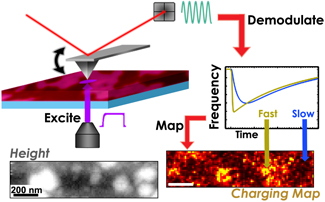
A team from the Center for Interface Science: Solar Electric Materials, or CISSEM, recently published a technique in Nano Letters for measuring events as fast as 100 nanoseconds on areas as small as 80 nanometers. This technique is based on atomic force microscopy, or AFM, a popular method for taking images of surfaces with resolution of billionths of a meter. However, AFM is poor at measuring how quickly events happen. For example, AFM can provide a detailed image of a plastic solar cell, but it provides little information on how efficiently sunlight is converted into electricity. The CISSEM team's new method combines the high-resolution images of AFM with 1000-fold improvement in time resolution.
Traditional approaches for measuring fast events in AFM often involve expensive, ultrafast lasers and complex optical alignment. The CISSEM team use affordable equipment and mathematical techniques to achieve the same end. The nanosecond time-resolution means it is now possible to investigate nanoscale dynamics that affect a wide range of materials and interfaces previously inaccessible—including the local origins of photocurrent in a solar cell—at a fraction of the cost.
Measuring Charging Times Helps Improve Solar Devices: A solar cell converts incident light into electricity. If you shine a pulse of light on an inefficient material, current is generated slowly; on an efficient material, current is generated quickly. Because of the complicated local structure in many modern solar devices, particularly plastic solar cells, the efficiency varies considerably throughout the material.
Combining measurements of charging times with nanoscale images lets scientists pinpoint the regions where solar materials generate current the fastest, with sensitivity far beyond other tools. The reported technique can be used on full devices under realistic conditions, thereby directly correlating device performance with charging times measured over nanometer-sized regions.
A Simple Solution for Fast Measurements: In AFM, a sharp metal tip vibrates a few nanometers above a surface at a specific rate called its "resonance frequency." Imagine a tuning fork that rings when you strike it; the note you hear depends on its resonance frequency. The resonance frequency of the AFM tip depends on how much electrical charge is in the surface underneath. Additionally, the time it takes the AFM tip’s resonance frequency to change depends on how quickly charge is built up underneath it.
To measure this charging time, the reported technique records the AFM tip position as a function of time as a light pulse is applied to the sample. The light pulse is controlled to happen only at a specific point in time. The position signal is numerically converted to a frequency versus time signal. By measuring how quickly the resonance frequency changes, it is possible to determine the charging time to 100 billionths of a second. The novelty of the CISSEM team’s technique is in its application to solar energy, and in acquiring the frequency versus time using only a combination of mathematics and time-synced averaging while at the same time achieving time-resolution less than a single up-and-down motion of the AFM tip.
The Next Application: The CISSEM team is looking at how different molecules used deliberately to modify interfaces affect solar cells. New types of molecules can be used to create more efficient solar cells by modifying the electrodes used. The reported technique can measure the rate of both charge generation and decay in systems using new molecules. Additionally, many next-generation solar cell materials break down when exposed to air. The AFM technique can show where on the surface this occurs and at what rate. The ultimate goal is a better understanding of how nanometer-scale phenomena affect device efficiency.
