
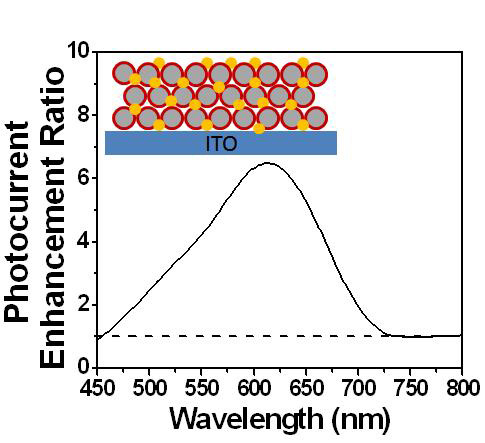
Researchers at the Center for Energy Nanoscience, or CEN, have demonstrated dramatically increased efficiency in thin solar cells by using small gold particles to concentrate light into the cell. New types of solar cells that leverage cheaper materials and fabrication methods could make solar energy more affordable. However, most of these new designs do not yet show high enough efficiency to compete with conventional silicon-based solar technology. One strategy to decrease cost but keep efficiency high is to make the solar cell material thinner, and concentrate sunlight into the cell.
The thickness of a conventional silicon solar cell is balanced so that it is thick enough to absorb as much sunlight as possible but thin enough for the electrical charge to be collected efficiently to generate electricity. Light absorption excites electrons into a more mobile state. The excited electrons travel through the thickness of the silicon where they are collected by electrical contacts to produce a light-generated current, or photocurrent. A measure of the efficiency of a solar cell is the fraction of the incoming light that is converted into photocurrent.
Dye-sensitized solar cells, or DSSCs, are one new type of solar cell that can be made both thin and from cheap materials. However, there are challenges in making high-efficiency DSSCs. In a DSSC, a ruthenium-based dye absorbs the light, exciting electrons within the dye. The excited electrons must then transfer from the dye to a porous film of titanium dioxide particles, which carry the electrical charge to produce photocurrent. Both incomplete light absorption by the ruthenium dye and poor transfer of electrons from the dye to the titanium dioxide lower the efficiency of the DSSC. The CEN researchers showed that they could increase the photocurrent produced by the DSSC by taking advantage of a property of small gold particles called a "plasmon resonance."
Plasmons arise from the interaction of electromagnetic waves, such as visible light, with small metal particles with sizes ranging from 5 to 100 nanometers in diameter. To provide a sense of scale, the thickness of one sheet of paper is about 100,000 nanometers. The excitation of electrons by light at a particular frequency results in resonant oscillations of the free electrons, such that they collectively move back and forth within the metal nanoparticle. The process is similar to the standing waves created in a trough of water when the right pressure is applied across the water’s surface. Because the oscillation of electrons within the metal particle create high electromagnetic field intensities near its surface, the plasmonic particle is very effective at collecting light and focusing it into a small region, much like an antenna.
Professor Stephen Cronin of the University of Southern California, who led the team of researchers, says, "One of the main problems limiting the efficiencies of DSSCs is related to the very small thickness of the dye monolayer. The plasmonic nanoparticles couple light very effectively from the far field to the near field at the absorbing dye molecule monolayer, thereby increasing the local electron-hole pair, or exciton, generation rate significantly."
The CEN scientists embedded gold nanoparticles within the porous titanium oxide layer of the DSSC and found that the photocurrent doubled compared to a similar cell made without the gold particles. The photocurrent was measured as a function of the wavelength of light, and the team found that the largest current enhancement occurred near the plasmon resonance frequency of the gold nanoparticles. This result indicates that the plasmonic gold particles enhance light absorption in the ruthenium dye to create more excited electrons and increase photocurrent. While the observed efficiencies in the plasmon-enhanced DSSCs are still not comparable to that of silicon solar cells, further optimization may improve their efficiency.
Plasmon absorption enhancement in solar energy materials is also being pursued by other Energy Frontier Research Centers. Scientists at the Light-Material Interactions in Energy Conversion Center have shown that a nanostructured silver film can both serve as the electrical contact to collect excited electrons and lead to increased photocurrent in thin silicon solar cells. Researchers at the Center on Nanostructuring for Efficient Energy Conversion have demonstrated enhanced photocurrent in iron-oxide-based devices containing embedded gold nanoparticles. Thus, plasmonic absorption enhancement could be a powerful strategy for achieving high-efficiency, low-cost solar energy devices.