
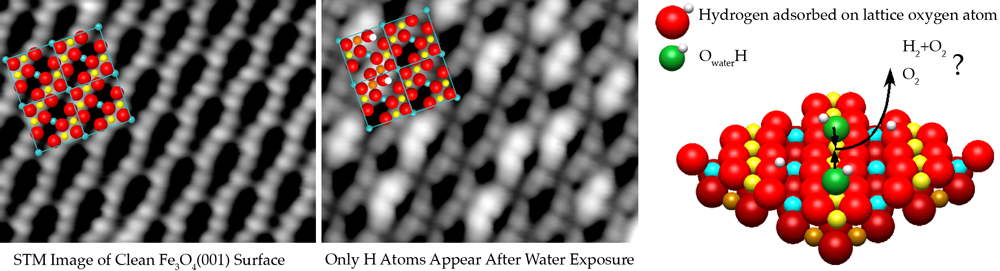
Efficient water splitting holds immense promise as a way to produce hydrogen for clean, sustainable energy conversion processes. Scientists working in the Center for Atomic-Level Catalyst Design, or CALCD, discovered that a form of rust, magnetite (Fe3O4), one of the most abundant materials in the Earth’s crust, performs water splitting at room temperature without the need for electricity or light to drive the reaction.
Significant increases in federal government funding in the alternative energy research field also reflect the importance of it to deal with the ever-increasing global energy demand, limited natural resources and climate change concerns.
Where did all the oxygen go?
The research team discovered the water-splitting reaction while studying the surface of magnetite in an ultra-high vacuum environment. They noticed that when they exposed the magnetite surface to small amounts of water (H-O-H), only one hydrogen atom from the water molecule was visible in atomically resolved images of the surface; the remaining OH from the water had vanished.
“For a long time we assumed that the OH was really there and just somehow invisible in the STM images,” explained Gareth Parkinson, lead author on the paper.
To solve the mystery, they dosed labeled water (H218O) on the magnetite surface and performed ion-scattering experiments, which revealed no trace of the 18O oxygen atoms on the surface.
“Taken together, these experiments point to the intriguing possibility that the Fe3O4 surface might split water at room temperature,” says Ulrike Diebold, who led the research team at the Vienna University of Technology, a partner institution in CALCD.
With the experimental evidence that the magnetite surface irreversibly splits water in hand, the team explains that the most likely scenario is that water initially splits into H and OH species, and then the OHs react with each other to create species that are not bound to the magnetite surface at room temperature.
What’s next?
The team is investigating, both experimentally and theoretically, in collaboration with theorist Dave Sholl (Georgia Tech, from the CALCD), the nature of the gaseous products from the surface to validate the model and better understand how this surprising reaction mechanism takes place.